
Not far from the hustle of Calcutta, there’s a spot where history decided to make an unexpected landing. We’re talking about an airbase napping until destiny decided to shake things up. This is Kalaikunda’s journey from its sleepy past to its starring role in the subcontinent’s most breathtaking aerial duels.
The Beginning
Kalaikunda Airbase’s history began in late 1943 during World War II. The United States initiated Operation Matterhorn to counter Japan’s offensive, selecting Kalaikunda as a key airfield for transiting B-29 bombers. Southern Bengal’s strategic importance, including Kalaikunda, stemmed from its location, Calcutta’s port facilities, and its robust rail network.

Building the airfield at Kalaikunda wasn’t a walk in the park. The U.S. Army’s 930th Engineer Regiment took the lead, backed by a army of 6,000 American troops and a whopping 27,000 civilians. The initial setup boasted a modest 5,000-foot runway and a lone combat hangar. But, as with all great projects, they faced their fair share of hiccups. Despite these challenges, by July 1944, Kalaikunda was up, complete with hutments, admin buildings, and the whole nine yards.

Kalaikunda played a significant role, mainly operating C-46s and C-109s to transport aviation fuel and supplies over ‘The Hump’. The airbase was crucial for several operations, including the April 1945 airlift of the 22 Battalion of the 77 Para Brigade to Akyab.

Post WWII twists
Following World War II, Kalaikunda Airbase was deemed surplus to the requirements of the Air Force. A role it played during this time was serving as a sanctuary for individuals fleeing East Pakistan amid the partition of India and Pakistan.
Following India’s independence, Kalaikunda Airbase regained strategic significance due to its proximity to East Pakistan. In October 1947, a committee identified Kalaikunda as a permanent and Barrackpore as a temporary location for a Fighter Wing comprising three Tempest Squadrons. The committee also suggested building a second 2000-yard runway at Kalaikunda.

The Kashmir conflict in 1947 ironically slowed down the development of Kalaikunda, as attention shifted to the Western front. Although five Wings were established in the following years, Kalaikunda was only formally set up as the 5 Wing in 1956.
Birth and the Mystere Era
Wing Commander Zafar Shah, a Vir Chakra awardee from the 1947 Kashmir War, led the advance party to reopen the Kalaikunda airbase on November 9, 1956. Air Marshal Subroto Mukherjee’s landing on December 27, 1956, marked a milestone, as it was the first aircraft to land on the base’s then 1,000-yard runway.

On December 14, 1956, Kalaikunda Airbase formally established as 5 Wing with an expanded 2,700-yard runway, surpassing the British standard of 2,000 yards. This expansion also included modern hangars, administrative buildings, and residential areas. The base had notably robust infrastructure, including concrete roads, which was a departure from usual practices. Martin Burn & Co., a private contractor, was responsible for its construction.
The Indian Air Force’s decision to station its newly acquired Mystere fleet at Kalaikunda was interesting, indicating a strategy to consolidate new aircraft operations. The base’s proximity to Pakistan suggested a relatively low threat perception from that direction at the time. In May 1957, 1 Squadron, equipped with Mystere aircraft, arrived at Kalaikunda. Over the next year, 3 and 8 Squadrons also moved, pinning fighter operations squarely on East India’s map.

The base featured married officers’ bungalows, but accommodations for single officers were still under construction. A rail link was established for fuel transport, and the base also hosted a team of French engineers for technical support. Life at Kalaikunda was challenging due to limited local amenities, with the Railway Anglo-Indian Club at Kharagpur serving as a social hub, evoking scenes from the 1956 movie ‘Bhowani Junction’. The base became a sought-after posting for bachelors; many a Stewart Granger met their Ava Gardner and learned to ‘roll off the top’.

The region is known for ‘Kalbaisakhi’ or Nor’westers during the summer. A severe storm in 1959 exemplified this, causing significant damage to hangar doors and some aircraft. All pilots vividly remember this event, recalling how pilots would fly out ahead of these storms.
In August 1960, the three Mystere Squadrons participated in a simulated strike on INR Mysore, escorted by frigates in the Bay of Bengal. At the same time, the 29 Squadron, outfitted with Toofani jets, was assigned to Tezpur for operations concerning the Naga insurgency. But they ended up staying at Kalaikunda, squeezing the base’s capacity, designed for three but now hosting four squadrons. The personnel of the 29 Squadron stayed at Budharia Camp, a basic facility compared to the main base.
Today happens to be the last day in tents. We would have stayed on in tents for years if it hadnt been for the menacing monsters, the Norwesters
A note in the 29 Squadron Diary

All the units used Balasore for range activities, lacking a dedicated training range at Kalaikunda. Group Captain Subia, the station commander, proposed using the unused WWII-era Dudhkundi base for bombing and gunnery exercises. By the end of 1961, the 29 Squadron left, and in October 1962, all Mystere Squadrons relocated to the western front. This relocation marked a new phase of greater turmoil for Kalaikunda Airbase.

Pre-1965 War
Kalaikunda Airbase came into its own over time. By June 1960, it welcomed the 55 Signal Unit, equipped with the T-15 Marconi Radar. This boosted local flying surveillance and helped with Ground-Controlled Intercepts for the Sector Operations Centre at Barrackpore.
By October 1962, the airbase witnessed a complete overhaul in its aircraft lineup. It included the Hunter jets of 14 and 17 Squadron, 16 Squadron equipped with the Canberra, and 47 Squadron operating the Toofani. But by the second half of 1963, 17 and 47 Squadrons left, moving further east for potential threats from China. In early 1964, 24 Squadron and 221 Squadron arrived, performing a training role with the Vampire. This likely reflected a continued low threat perception from East Pakistan.

In 1963, Kalaikunda enhanced its capabilities by officially incorporating an air-to-ground armament firing range at Dudhkundi and an over-sea range near the Digha-Balasore coast in Orissa. This expansion made it the second airbase in India to provide such facilities. Around the same period, it also became the alternate base for the air wing of India’s spy agency.

November 1963 was significant for Kalaikunda Airbase. It hosted India’s first international air exercise, Exercise Shiksha. This exercise aimed to improve India’s air defence systems and procedures, involving aircraft like Javelins, Super Sabres, Hunters, and Gnats in defence roles against attacking Canberras from the Royal Australian Air Force and the Indian Air Force. This significant event tested the airbase’s facilities. It even brought the Budharia Camp back into action, now renamed Shiksha Camp. The camp accommodated bachelor officers posted to Kalaikunda for the next two decades.

Ex- Shiksha was undertaken. Source: The Aviation Historian
In October 1964, things got interesting. Pakistan’s 14 Squadron moved to Dacca with 12 F-86F Sabres and the same number of pilots. Little did Kalaikunda know that this squadron would become a big part of its history.

1965 War
On September 7, 1965, Kalaikunda Airbase witnessed intense aerial combat. The day began with a daring mission by 16 Squadron’s Canberra, led by Wing Commander Pete Wilson, targeting the Chittagong runway to neutralise the Pakistan Air Force’s 14 Squadron. Although they hit the runway, the PAF squadron was not present.
Following this mission, the PAF’s Sabres from 14 Squadron attacked Kalaikunda. With no resistance, they freely bombed the base. Wing Commander Wilson observed and narrated the attack from the Air Traffic Control terrace. Unfortunately, Kalaikunda’s air defence guns were inoperable and covered for weather protection. This assault destroyed four Vampires from 221 Squadron and the two Canberras that had just returned from Chittagong.

The PAF carried out a second raid around 10:30 AM, destroying two more Canberras. However, the Indian Air Force’s 14 Squadron, airborne from Dum Dum, engaged the PAF. Flight Lieutenant Cooke and Flying Officer Mamgain participated in an epic air duel, successfully downing three PAF Sabres. Sameer Joshi’s detailed account argues for recognising Cooke’s bravery. For Group Captain MB Naik, the Station Commander, and the IAF, it was a day of mixed outcomes. The air combat success of 14 Squadron somewhat offset the initial losses. For aviation enthusiasts, this day was extraordinary.

In-between Wars
Post-1965 war, Kalaikunda underwent significant changes. The Vampires of 24 and 221 Squadrons left in early 1966, and the Canberras of 16 Squadron had already departed. Between 1966 and 1968, 48 Squadron, a transport unit, was based at Kalaikunda. The Gnats of 22 and 24 Squadrons arrived in 1968, chosen for their quick response and agility, which proved invaluable in 1971.

Since 1965, helicopter detachments for Air Sea Rescue have also operated at Kalaikunda. The initiative started in June 1965 with the 107 Helicopter Unit using a Mi-4. In the 1980s, the 122 Helicopter Flight with Mi-8 briefly took this role. However, the 142 SSS Flt has been the primary unit for most of Kalaikunda’s history.
In July 1971, as tensions rose, 30 Squadron equipped with MiG-21s was deployed to Kalaikunda Airbase, taking over from 24 Squadron’s Gnats. By the time the war began, the base was home to squadrons of Hunter, Gnat, and MiG-21 aircraft, all prepared for combat.
1971 War
Amid escalating tensions between India and Pakistan, the 22 Squadron, led by Wing Commander BS Sikand and based at Kalaikunda, operated a detachment from Dum Dum. On November 21, 1971, a significant tank battle took place between the Indian and Pakistani armies at the Boyra peninsula. The following day, they witnessed a dramatic turn of events when F-86 Sabres from the PAF’s 14 Squadron intruded into the area thrice. During their third intrusion at 1448 hours, four Gnats piloted by Flight Lieutenant Roy Andrew Massey, MA Ganapathy, and Flying Officers Don Lazarus and Sunit Soares engaged in a fierce dogfight with the Sabres over Boyra. This intense aerial combat led to the downing of three PAF Sabres, and one of the captured pilots, Parvez Mehdi Qureshi, eventually rose to become the Chief of the Pakistan Air Force.

Wing Commander Sikand received the VSM (Vishisht Seva Medal), while pilots Massey, Ganapathy, and Lazarus were awarded the Vir Chakra. Additionally, the fighter controller Bagchi was honoured with the Vayu Sena Medal. The 22 Squadron earned the distinguished nickname “Sabre Slayers.” Further details of this event and personal accounts from the pilots can be found in the videos.
On December 11, 1971, the 2nd Para Battalion of the 50 Independent Parachute Brigade executed a pivotal airdrop near Tangail, approximately 70 miles from Dhaka. Their mission was to secure the Poongli bridge over the River Jamuna to prevent the retreat of the Pakistani 93rd Brigade to Dhaka. This operation represented the largest air transport effort by the IAF, involving 48 aircraft, with 22 Dakotas from Kalaikunda playing a critical role in this strategic operation.
Furthermore, the Hunters of 14 Squadron, based in Kalaikunda and operating from Dum Dum, achieved a unique distinction. They became the only Indian unit to operate from an enemy airfield, Jessore, towards the end of the campaign.
Taking over from Jamnagar
Pete Wilson, the 16 Squadron CO during the 1965 war, was again in the spotlight in 1971. As the Jamnagar station commander, he used his Kalaikunda experiences to protect the base from PAF raids. Back then, Jamnagar was all about training pilots in air combat. Following the 1971 war, the situation evolved. With Bangladesh emerging as a friendly neighbour, Kalaikunda’s strategic significance altered. It began to undertake roles like those performed by Jamnagar since 1951.
Kalaikunda Airbase transformed into a fighter conversion and armament training base over five years. Following the war, the 14 Squadron transitioned to a training role. In 1973, the 22 and 30 Squadrons departed from Kalaikunda, making way for the 17 and 37 Squadrons. These new squadrons operated Hunter and MiG-21 aircraft, mainly focusing on type training. The tenure of both 17 and 37 Squadrons at Kalaikunda was short. In 1975, the Operational Conversion Unit (OCU), initially based in Jamnagar and using Hunters, moved to Kalaikunda. The Target Tug Flight, also employing Hunters, commenced operations in 1977. In 1978, Kalaikunda acquired the Chakor Pilotless Target Aircraft, the first drone acquired by IAF from the US.

By 1979, the 14 Squadron had completed an impressive 17-year tenure at Kalaikunda, a notably lengthy period for a military unit typically subject to more frequent relocations.

The Air-to-Air Range at Balasore was enhanced, with pilots using guns on Canberra or Hunter aircraft flying the banner. In mid-1974, Kalaikunda hosted the 118 Helicopter Unit for two weeks, during which they conducted their first range firing with 57 mm rockets. The range also saw the testing of several new missiles that would become staples.
Fighter Conversion Training
Formed in 1966, the OCU at Kalaikunda trained new fighter pilots using Hunters until 1991. People often called it HOFTU (Hunter Operational Flying Training Unit) to distinguish it from the MiG-21 OCU in Tezpur. After HOFTU, the 20 Squadron, transitioning from their Thunderbolt role, took over the training role until 1997. Meanwhile, the Target Tug Flight used Hunters until 2001, ending the aircraft’s service at Kalaikunda Airbase. This tenure made Kalaikunda the longest-serving base for Hunters, lasting nearly four decades.

In 2009, the OCU returned to Kalaikunda, training pilots on the MiG-21 FL (Type-77). December 2013 marked a significant moment at Kalaikunda, hosting a farewell for the Indian Air Force’s longest-serving MiG-21 variant, the Type-77. This event also signalled the disbandment of the OCU.

The 2 Squadron’s journey at Kalaikunda began in 1979, operating the Gnat in its final operational phase and for type training. In 1983, the squadron switched to Ajeets and retired them in 1991, becoming the last in the Indian Air Force to operate the Gnat and its successor. Kalaikunda witnessed the Gnat’s final flight, honouring its “Sabre Slayer” legacy.

Kalaikunda Airbase holds a somewhat quirky record in the annals of Indian Air Force history. It has witnessed the retirement of four fighter aircraft: the Hunter, Gnat, Ajeet, and MiG-21 FL.
Flogger Era
From 1991 to 2014, the MiG-27 ML dominated Kalaikunda’s airspace, echoing the consolidation of the Mystere fleet at the exact location in 1956. 2 Squadron operated the MiG-27 ML from Kalaikunda until 2005, focusing on ‘maritime strike’ role over the Bay of Bengal starting in the latter half of 1996. At the same time, in 1996, the 18 Squadron arrived. They began as the first-night strike unit in the Indian Air Force and later took over the maritime role from 2 Squadron. For two decades, they lit up Kalaikunda’s night skies.
In April 2012, the 22 Squadron moved to Kalaikunda for the third time. This move aimed to concolidate the Eastern Air Command’s MiG-27s. However, when fighter conversion training resumed at Kalaikunda, the plan changed. The MiG-27 operations were then shifted to Hashimara. As a result, both the 18 and 22 Squadrons were relocated out of Kalaikunda Airbase in early 2014.

The MiG-27s have profoundly influenced Kalaikunda’s culture. The officers’ mess bar proudly displays parts from these retired aircraft as a tribute, and there is even a dedicated ‘graveyard’ for decommissioned MiG-27s.
The “graveyard” area at Kalaikunda Air Base is designated for aircraft that have been decommissioned. In 1957, five Spitfires from the 14 Squadron were moved to Kalaikunda to serve as decoys. Over time, these aircraft became permanent fixtures in the graveyard. Today, this unique base section is home to several retired MiG-21s and MiG-27s. The sight of these majestic, once-powerful aircraft, now silent and stationary, continues to evoke a sense of awe and reverence.

Present Day Kalaikunda
Today, Kalaikunda Airbase plays three critical roles for the Indian Air Force. First, it’s still a central hub for armament training, with the modern version of the Pilotless Target Aircraft. Second, it’s big on conversion training, hosting two Hawk 132 Advanced Jet Trainers squadrons since 2014-15.

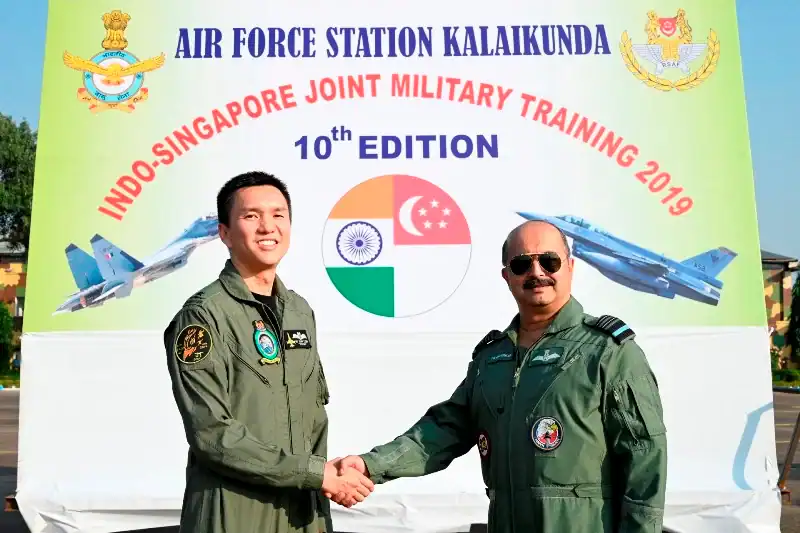
But one of its coolest roles? Kalaikunda is the go-to base for most of the IAF’s international exercises. It’s keeping up a tradition that started in 1963 when it hosted the first multinational exercise. While the skies above Kalaikunda might not see combat anymore, the legendary air fights of the past have left a lasting mark.


Leave a Reply