

Aerobatic flying has captivated audiences since the earliest days of aviation. The Indian Air Force has a longer aerobatics tradition than most people realise, stretching back to the final years of the Second World War. What follows is an attempt to trace the evolution of aerobatic teams in the IAF. Flypasts in Box and Balbo formation on various occasions were frequent, but formation aerobatics was another matter entirely.

The first ever display team was formed in 1945 and was called the IAF Display Flight — well after considerable internal debate over the name. They had six Spitfires, four Cornells and two Harvards. Wing Commander Jumbo Majumdar, Mehar Singh and Arjan Singh served as Commanding Officers.
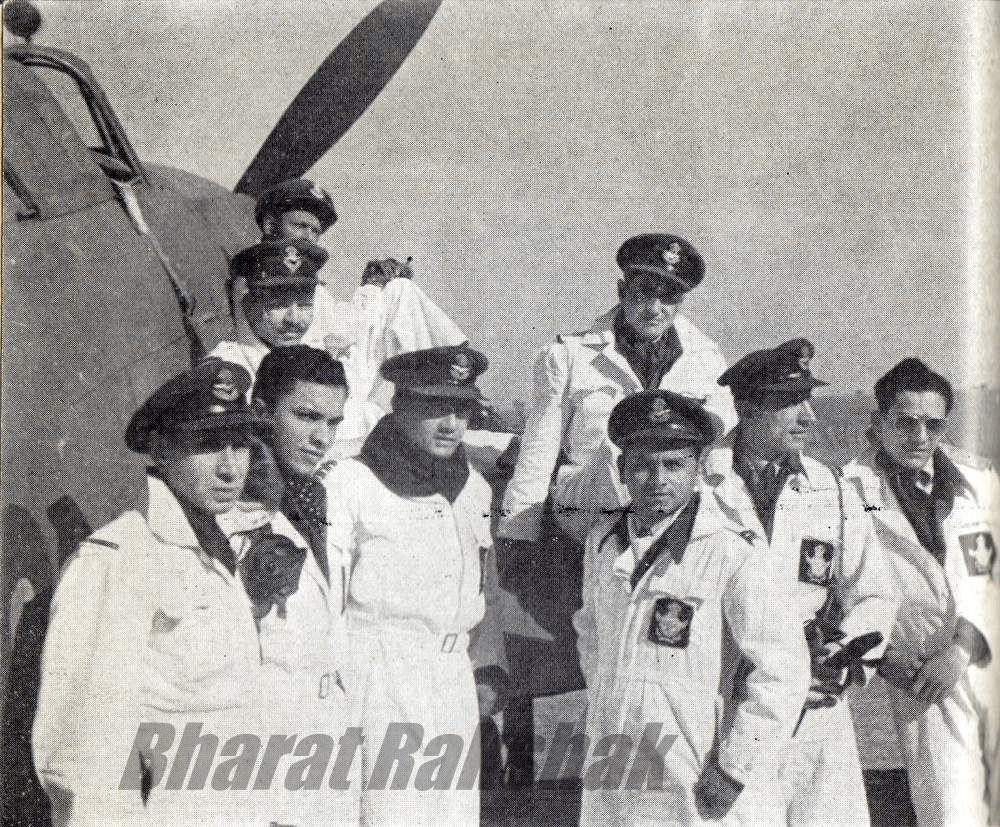
Wing Commander Jumbo Majumdar, the team’s first CO, sadly perished in an air accident in February 1945. The flight was disbanded, then reformed as Demonstration Flight in September 1945 with Wing Commander Mehar Singh as CO. It would only be operational for another few months before Partition drew all focus away.

Fast forward to 1951, it emerges that No. 7 Squadron would find itself leading the charge. In September 1951, No. 7 Squadron was equipped with the Vampire aircraft and was given a free hand to test it thoroughly. From this emerged a four member team led by Dicky Law.

They performed on 13 February 1952 at Eden Gardens, with none other than PC Lal — later Chief of Air Staff — as commentator. The team performed at the Race Course soon after, and Bharat Singh (3582) joined in after Dicky Law left. The team soon disbanded with the pilots getting posted out.
Bharat Singh and No. 7 Squadron would return in the late 1950s, this time on the Hunter aircraft. Having done aerobatics earlier, he was encouraged to form an aerobatics team and came up with a four aircraft formation. It would be in order to quote the man himself:
We progressively lowered our height from 10,000 ft down to 500 feet above ground level. Forget about aerobatics which was limited to 10,000 ft, even straight and level flight was totally banned below that height. I obtained special dispensation to perform aerobatics.

They performed across the country and were asked to grow into a nine aircraft formation. The first nine aircraft formation aerobatic display was flown on 06 January 1962 on the occasion of the squadron’s 20th anniversary. More on this team can be read here.

For his role in formation aerobatics, Bharat Singh would become the first IAF officer to be recognised with a Vayu Sena Medal.

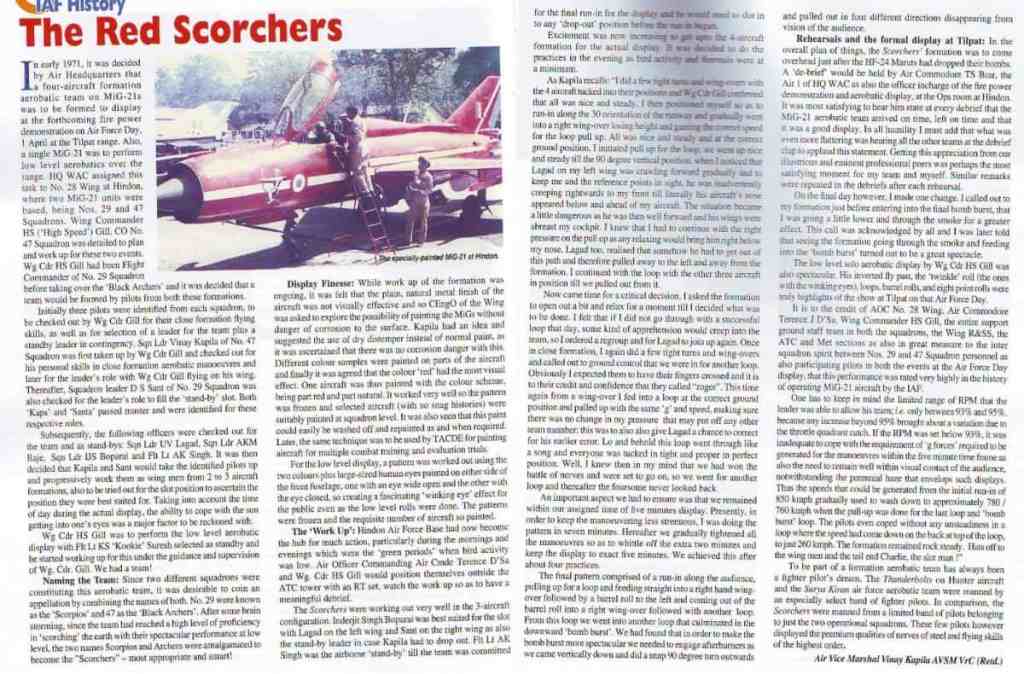
Early in 1971, Air Headquarters authorised a four aircraft MiG-21 aerobatics team to be based at Hindon. No. 29 and No. 47 Squadrons contributed aircraft and pilots. The team was named Scorchers — a portmanteau of the two squadrons that contributed, the Archers and the Scorpions.

The team was led by the CO of No. 47 Squadron, Wing Commander HS ‘High Speed’ Gill, and included Squadron Leaders Kapila, DS Sant, Lagad, Boparai, Raje and AK Singh. The first performance at Tilpat was a raging success. Gill performed low level aerobatics — inverted flypast, Twinkle roll, loops, barrel rolls and eight point rolls.
The team disbanded soon after. In 1980-81, the Flying Instructors School at Tambaram formed a four aircraft team on the Kiran aircraft, calling themselves the Silver Streaks. At Republic Day 1981, they were across the newspapers, with national colours streaming from three Kirans framing Rashtrapati Bhavan.
They also featured in the Air Force calendar. Anil Trikha, Kuldeep Shiva, Nanderjog, Marcus Dare, Shyam and Ghalawat were the pilots. This team too disbanded soon after. But a permanent team was now on the horizon — the first since 1945.
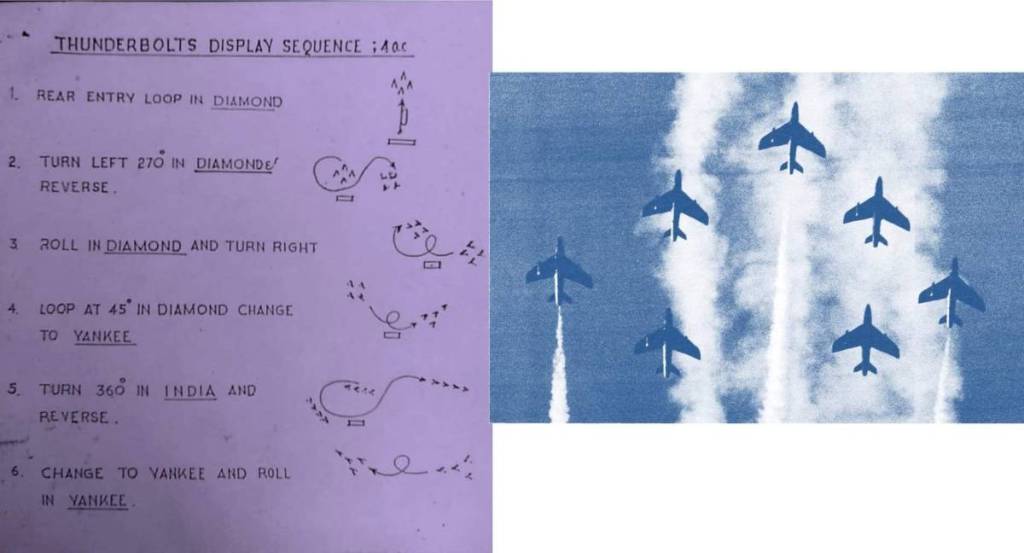
To commemorate the Golden Anniversary of the IAF in 1982, No. 20 Squadron — the Lightnings — was earmarked for the dedicated role of formation aerobatics with the Hunter aircraft, based at Hasimara. The aerobatics display team was named Thunderbolts and would remain in existence for eight years.

The inaugural team had 13 members, led by Prithvi Singh Brar ‘Ben’ in his favourite aircraft, BA 472. Ben had been deputed to the Red Arrows, who could not believe that a nine aircraft team could be assembled on the ageing Hunter in just a few months. Ben made it happen.

The last performance was at Tilpat on 18 April 1989, led by TS ‘Teji’ Randhawa, who had fittingly also been part of the inaugural display in 1982. In 1982, a colour scheme of dark blue and white strips was agreed upon. The unit designed the strips to look like the ‘bolts’ of ‘lightning’.

By the time the Thunderbolts wound up, they had four team leaders and 30 members. More importantly, they had created a syllabus and aerobatic manoeuvres of a standard never seen before in the IAF. The members of the Thunderbolts would play a crucial role in the formation of the next team — the Suryakirans.
Concurrently, thought was given to forming an aerobatics team at the Air Force Academy on the Kiran Mk I. Group Captain Badhwar, as Chief Instructor, was tasked. However, it proved a no-go — the aircraft was underpowered and vertical manoeuvres did not look good. He did, however, perform a solo low level aerobatic show in a Kiran painted red.
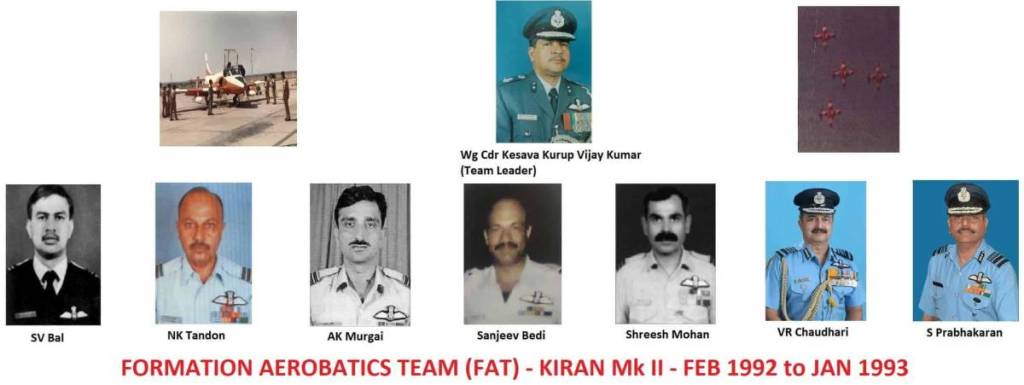
Subsequently, a team on the Kiran Mk II was formed and named the Formation Aerobatics Team (FAT) at Bidar. They performed at the IAF’s 60th anniversary in a camouflage scheme distinct from that of today’s Suryakirans. The team was wound up soon after, but not before proving the Kiran Mk II as a viable aerobatics aircraft. The current Chief of Air Staff, Air Chief Marshal VR Chaudhari, was a member of this team.

Serious planning began for Aero India 1996, the first major air show and aviation trade event ever hosted in India. In May 1996, then Wing Commander Kuldeep Malik, who had been a member of the Thunderbolts, was posted to Bidar with instructions to raise a new aerobatic team.

After much deliberation, it was initially mandated to be a six aircraft team. Many believed the Kiran Mk II lacked the required thrust to weight ratio, and the side by side seating cockpit of the Kiran Mk II imposed additional restrictions.

Two aircraft were painted in different schemes — ‘post-box red’ and ‘day-glo orange’ — and shown to the Chief of Air Staff, who chose the latter. An Indian name, Suryakiran, was selected for the team. On 15 September 1996, the team went public for the first time at Coimbatore in a flawless display that included the Goblet roll and the Tango roll.

With effect from 01 May 2006, the team became No. 52 Squadron. They were numberplated in 2011. In 2015, Suryakiran was raised again on the Hawk Mk-132 aircraft and has remained the longest performing aerobatics team in IAF history. Nearly 100 pilots have worn the Suryakiran overalls since the team’s formation.
The Kiran Mk II aircraft given up by Suryakiran in 2012 found their way to the Air Defence Flight at Gorakhpur in 2015. While display flying is not their primary role, the pilots still perform at various events carrying the original Suryakiran livery — as seen in this excellent photograph.

A three aircraft formation aerobatics team was assembled for Aero India 2003, flying the Mirage 2000 — the first time the type was used for display flying. The team consisted of a mix of pilots from both No. 1 and No. 7 Squadrons. These photographs from the time are credited to Group Captain Jaspreet Singh.

Finally, the IAF raised its first helicopter display team — Sarang — in October 2003 on the ALH Dhruv, later given the status of 151 HU at Yelahanka. Along with the Thunderbirds and Suryakirans, Sarang is one of only three IAF display teams to have performed internationally.

Aerobatics is about precision and the best make it. Many have perished in accidents and we must never forget them. The team performs to build confidence in the capabilities of the IAF and to motivate Indian youth. A book on aerobatics in the IAF would be a fitting tribute.

Post Script — Angad Singh added some details on Indian Navy aerobatics display flying in response to the original publication of this piece.


Leave a Reply