
Heritage is the lifeblood of any armed force, the thread that connects past glories to present identity. But imagine that thread being violently cut, leaving an army adrift. In 1947, as India was cleaved in two, the Indian Air Force faced just such a crisis. Amidst the chaos of Partition, the IAF was stripped bare, seemingly losing its very connection to its own history. But the story doesn’t end with loss. As I wrap up 2024 with my 28th blog post on IAF history this year, I’m sharing a remarkable tale of reclamation: how, amidst the turmoil of the Kashmir War and within mere months of Partition, the IAF clawed back its legacy from the ashes of division.
The Lost Heritage: A Deep Wound
The history of air power in India dates back to 1915 when the Air Force was organised as a Command. Over the years, a clear hierarchy evolved, mirroring Royal Air Force structures, with Groups, Wings, and Squadrons forming the backbone. Central to this lineage were three entities that embodied the pre-Partition legacy:
No. 1 (Indian) Group: Established on 1 November 1928 at Peshawar, it was the India’s first operational Group. Renamed No. 223 Group during World War II to align with RAF nomenclature, it reverted to its original name on 15 August 1945. This Group spearheaded operations across the North-West Frontier Province, the Air Force’s primary theatre of operations until World War II expanded its horizons to Burma.

RAF Kohat (formerly No. 1 (Indian) Wing): Initially formed as No. 1 (Indian) Wing in the 1920s and based in Peshawar, it later moved to Kohat, the strategic hub of the North-West Frontier. By the 1940s, the Wing had become RAF Kohat, operating advanced landing grounds at Miranshah and Fort Sandeman. Kohat was more than just a station—it became the first IAF-commanded Wing, a symbol of the Air Force’s growing stature. Commanded by stalwarts like Subroto Mukerjee, Aspy Engineer, Mehar Singh, and Arjan Singh, Kohat was, as Harjinder Singh aptly put it, “an IAF station.”

No. 1 Squadron, IAF: Formed in 1932, No. 1 Squadron was the beating heart of the Indian Air Force, from which the service grew to a ten-squadron force by 1947. It symbolised the IAF’s legacy, its spirit, and its aspirations.
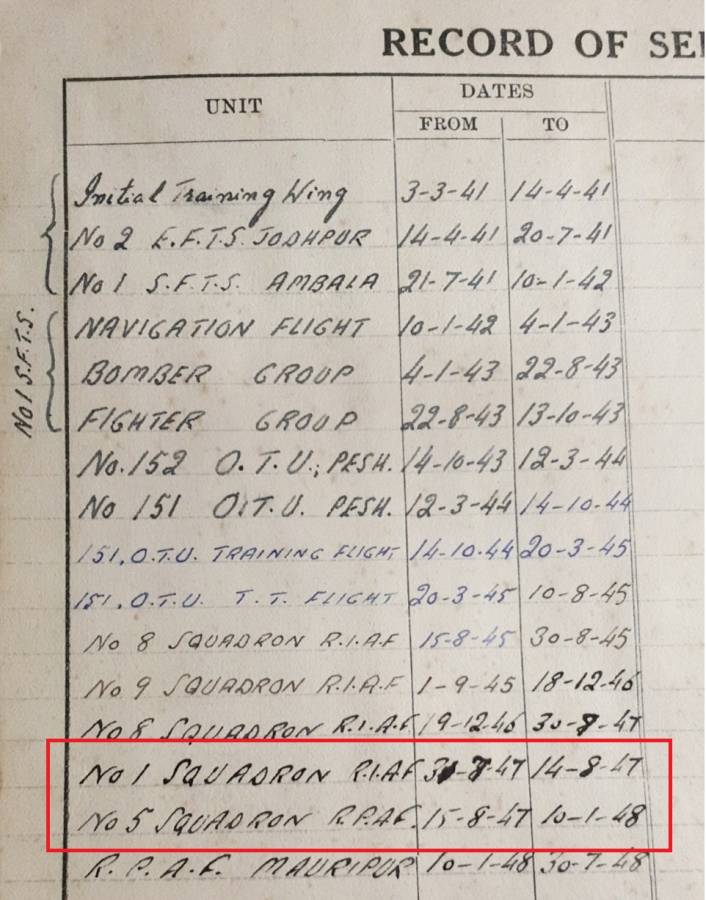
Partition dealt a cruel blow to the Indian Air Force, stripping it of its most cherished legacy. No. 1 (Indian) Group, based in Peshawar, was handed over to Pakistan and became the headquarters of the newly formed Pakistan Air Force (PAF). India retained No. 2 (Indian) Group in Bangalore, but the loss of its predecessor was keenly felt. Similarly, Kohat, home to No. 1 Wing and an integral part of IAF history, was geographically located in Pakistan and was lost along with its pivotal role in the North-West Frontier. The most personal loss, however, was that of No. 1 Squadron, IAF—the very heart of the Indian Air Force. The squadron was disbanded, and its Tempest aircraft were reallocated to the PAF’s No. 5 Squadron. By 15 August 1947, the IAF found itself stripped of its foundational elements, these entities now belonging to the nascent PAF.
The Resurrection: Reclaiming a Legacy
The losses inflicted by Partition were not something the senior leadership of the Indian Air Force —stalwarts like Subroto Mukerjee, Aspy Engineer, Mehar Singh, Arjan Singh, and others—were willing to accept passively. These pioneers, who had poured their blood, sweat, and passion into the service, ensured that the legacy of the IAF was not erased. Remarkably, within months of Partition, they achieved what seemed impossible—they resurrected all three entities: No. 1 (Operational) Group, No. 1 Wing, and the cherished No. 1 Squadron.
The timing was critical. Partition coincided with the outbreak of the 1947-48 Kashmir War, placing immediate operational demands on the IAF. In those early days of nationhood, governance structures were still developing, and Air Headquarters directly controlled all units—a significant deviation from established procedures. This was rectified on 22 December 1947 with the formation of a new Group Headquarters at Palam, tasked with overseeing all air operations across India. In a deliberate and symbolic act, this new formation was named No. 1 (Operational) Group, directly invoking its pre-independence predecessor. The legendary Air Commodore Mehar Singh became its first Air Officer Commanding (AOC), leading its critical operations during the Kashmir War. This formation is the direct ancestor of today’s Western Air Command, a cornerstone of India’s air defence.
At the time, the IAF had three operational Wings: No. 2 Wing at Poona, No. 3 Wing at Palam, and No. 4 Wing at Agra. The absence of No. 1 Wing was a stark reminder of the losses of Partition. During the Kashmir War, No. 3 Wing carried the heaviest burden, establishing Advanced Headquarters (Adv HQs) and detachments at Amritsar, Jammu, and Srinagar. Wing Commander E.W. Pinto led the Wing through this crucial period. However, a detail in the December 1947 operational report hinted at something more: Wing Commander M.M. “Minoo” Engineer, Pinto’s course-mate, had taken command of the Adv HQ at Jammu on 17 December 1947. This was unusual, as both officers held the same rank.
The reason for this unusual arrangement soon became clear: M.M. Engineer had explicitly been tasked with resurrecting No. 1 Wing. On 10 March 1948, No. 1 Wing officially stood up at Jammu, becoming the IAF’s spearhead in the Kashmir conflict. Years later, it relocated to Srinagar, where it remains a vital operational unit to this day, continuing its storied legacy.
The resurrection of No. 1 Squadron took a different path. Records from the Advanced Flying School at Ambala in October 1947 reveal that a detachment of Harvards and Spitfires, hastily armed with machine guns and bombs, was deployed to Srinagar with a small team of instructors. By November 1947, these records began referring to the detachment as “No. 1 Squadron.” This ad-hoc unit conducted vital reconnaissance and bombing missions from Jammu and Srinagar, earning two Vir Chakras and two Mentions-in-Dispatches for its instructors, among them future Chief of the Air Staff Dilbagh Singh.

However, as Vikram Singh’s Spitfires in the Sun explains, this was a temporary expedient, an “ad-hoc formation” drawn from training units to meet the immediate wartime need. By December 1947, the No. 1 Ad-hoc Sqn returned to its training role at Ambala, leaving no formal continuation of the original squadron. Had it lasted longer, it might have inherited the storied history of the original No. 1 Squadron. That formal resurrection of No. 1 Squadron finally came in 1953, and the squadron continues to serve as one of the IAF’s premier units, currently flying the Mirage 2000.

Setting the Record Straight
Within mere months of Partition, the IAF accomplished a remarkable feat: the resurrection of its three iconic entities—No. 1 Group, No. 1 Wing, and No. 1 Squadron. These “Ones” were immediately thrust into the crucible of the Kashmir War, carrying the weight of the IAF’s history and the pride of its personnel. For the officers and airmen, these were more than just units; they were symbols of resilience, a tangible link to the IAF’s formative years.

While No. 1 Squadron’s legacy remains well-known, the stories of No. 1 Group and No. 1 Wing have been largely overlooked. It’s time we correct this oversight. The deliberate act of reviving these units, retaining their original names, speaks volumes about the deep respect the IAF’s early leaders held for their heritage. Perhaps it is time we acknowledge and celebrate this act of preservation, setting the narrative right and honouring the legacy these units represent.
As the direct descendant of the original No. 1 (Indian) Group, the WAC’s incumbency board should explicitly acknowledge this lineage, ensuring that the legacy of these foundational units is fully recognised and honoured. The units with a pre-1947 lineage in the Indian Air Force include the Air HQ, Western Air Command, Training Command, and Wings at Srinagar, Palam, and Poona as well as some Base Repair and Equipment depots.

⭐ This post previously received 5.0/5 from 44 readers in our legacy system.


Leave a Reply