
Indian Air Force’s first operation ever was in Waziristan, at the modern-day Afghan border. At the heart of the IAF operations was a fort & the landing ground of Miranshah, an unusual airforce base. Fag end of “The great game” where IAF pilots were blooded. (1/26)
A quick history lesson – The North-West Frontier became part of British India in the aftermath of the Second Sikh War of 1849. The Brits divided the frontier into a ‘settled area’ under direct British rule, & an autonomous ‘tribal area’ directly adjacent to the Afghan border. 2/

The Brits had two aims – The first was to prevent raiding Pathan tribes (who fiercely resisted British control) from the mountains into the settled, law-abiding lowland areas. The second was to prevent a Russian invasion from the northwest (The Great Game!). 3/

From ~1900, British relations with Russia improved & most regular troops were pulled back from the tribal areas, left to be policed by local militias under the command of attached Indian Army officers. These included units like the Khyber Rifles and Tochi Scouts. 4/

Miranshah name emerges from the local Waziri pronunciation Miroom Shah, a small village that had a number of posts and forts, of which the most important was Tochi fort situated on the Southern edge of the Dande plain & banks of the Tochi river at an elevation of 3,100 feet. 5/

Initially, it was built by Brits as a post in 1905 occupied by Tochi Scouts but was considerably enlarged into the shape of a fort. Built of sun-dried mud blocks, rectangular in shape with towers placed so as to provide a clear line of fire along the lengths of the fort walls. 6/

On the inside, about five feet from the top of the walls was a platform about 10 feet wide. This ran around the perimeter of the fort and formed the roof of the living quarters below. Key villages in the area were Ramzak, Datta khel, Spinwam, Dosali, Shawal & Dawar 7/

Tribal raids continued through the years, but in 1919 the Afghans (3rd Afghan War) invaded Waziristan & the tribes rose-up at the same time. Over 10,000 troops of Indian Army took part in the campaign to re-establish Brit control of the border areas. ~1,300 men were killed 8/

Airpower played a key role. Five @RoyalAirForce sqns of BE2Cs, Bristol F2Bs, De Haviland DH9As & DH-bombers were used in strafing & bombing attacks on tribes & in Afghanistan itself. Bombings eventually brought the conflict to an end. MIRANSHAH had been used for many missions. 9/

Buoyed by the success, in Nov 1923, the Govt decided to make Miranshah as an RAF base, using the existing Scouts base to house RAF personnel. The North side of the fort was constructed in 1925 to accommodate RAF along with a runway for carrying out operations in Waziristan. 10/

Vindicating the decision, RAF in 1925 using Miranshah as a base under the command of Wg Cdr RCM Pink made the unprecedented decision to conduct air operations against the tribesmen without the support of the army. This would shape airpower and be known as “Pink’s War” 11/

They bombed tribals over 54 days by dropping 250 tons of bombs in day/night raids. It was the first time RAF was in combat independently. Tribal leaders relented by requesting an honorable peace on May 1, 1925. When the campaign ended only two lives & one aircraft was lost. 12/

Ever since RAF maintained at least a flight at Miranshah for ops on the Northwest frontier. Till about 1937, such flights were exclusively undertaken by RAF Sqns – 5,20,28,31 & 60 with Wapiti/Audax ac. Typically, flights used to remain for two months on a rotational basis. 13/

In 1936, Ghazi Mirzali Khan Wazir, nicknamed the Fakir of Ipi launched a jihad against British rule. His activities threatened communications with Razmak garrison. Over 30,000 troops, together with aircraft and armoured cars, were then deployed against his followers. 14/

Oblivious to these developments, in April 1936, for the first time since its formation in 1933, the solidary IAF Sqn – 1 Sqn had moved out of its nest at Drigh Road, Karachi to Peshawar (A Flight) to be co-located with 20 Sqn RAF, a veteran of the Waziristan operations. 15/

Despite the scale, IAF did not yet have the confidence of AOC, Peshawar – Gp Capt RN Bottomley and was asked to remain at Peshawar, in fact officers asked to go on leave. Till the red-letter day in August 1937 – when A Flight, 1 Sqn was asked to move to Miranshah. 16/

Life at Miranshah is well explained through memoirs of a few officers and men of those days, some of them reproduced here. The fascinating way of operating out of a fort with aircraft while being under fire remains unique till date. 17/
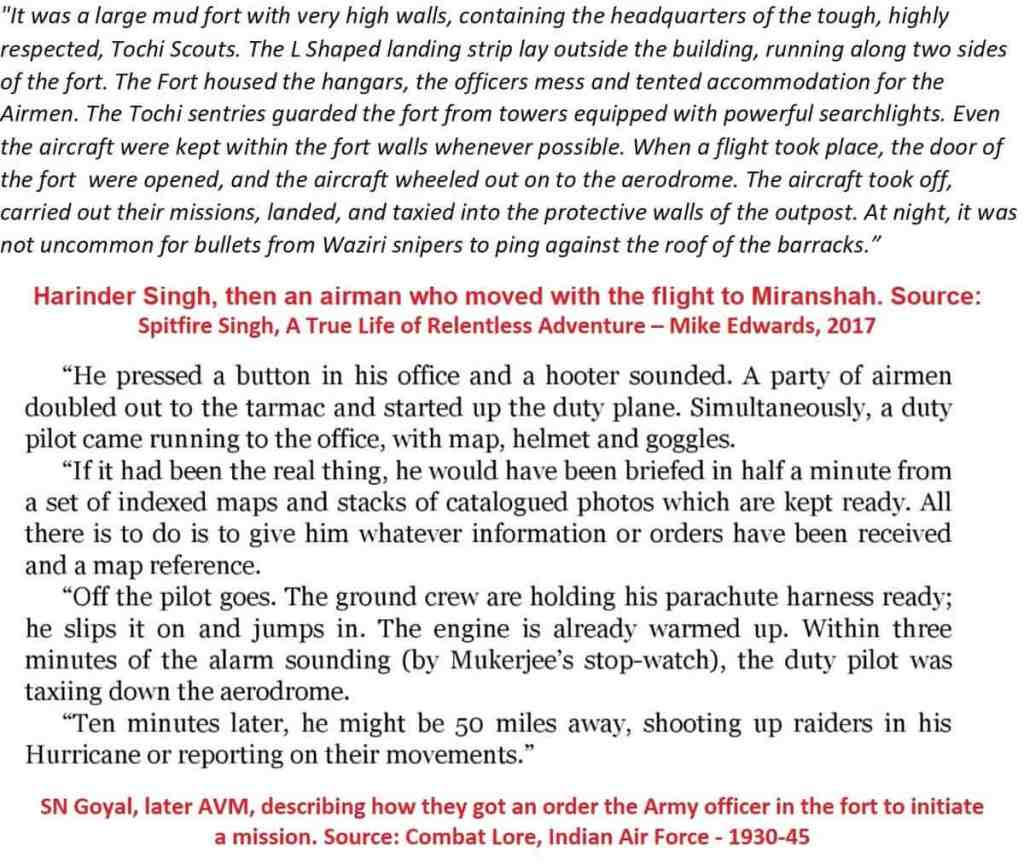
if a short runway, on-the-go review of maps, coupled with difficulty in acquiring targets under enemy fire was not enough, Miranshah was 3000 ft high & surrounded by hills. It was liable to sudden/severe storms, accompanied by hail which made flying both difficult & dangerous.18/

IAF’s first dett (A Flt, 1 Sqn) at Miranshah lasted from 31 Aug to 21 Oct 1937 and another 5 days in November. They flew 1,400 operational hours with 100% serviceability, breaking all prior RAF records. The IAF pilots had come of age and with flying colours. 19/

As IAF pilots gained in confidence, some ingenuine and brave moves came about. Once Subroto Mukerjee found a piquet surrounded, he threw ammo at them from his own guns that allowed the piquet to survive. 20/

Mehar Singh, never to find himself away from the action, was involved in a daring landing and then rescue through hostile territory. His Air Gunner, Ghulam Ali would find himself in multiple such hostile situations in years to come. 21/

Arjan Singh together with SN Goyal added to the “behind enemy lines” saga, this time using deception to find their way back. Arjan Singh would later also be in an Audax Crash with Ghulam Ali where he saved his and his gunner’s life from hostiles. 22/

The Champion of Waziristan for the IAF was hands down – Aspy Engineer (later Chief). He was one of the only 4 officers, and the only Indian, to get a Distinguished Flying Cross (DFC) for the Ops, apart from mention-in-dispatches twice. His DFC-earning feat was spine-tingling! 23/

While IAF lost a number of pilots to flying accidents ex-Miranshah, the only loss of life in operations was Flying Officer Moses on 13 May 1942 while flying the Lysander II of 4 Sqn, IAF during the siege of Datta Khel. 24/

IAF sqns kept a non-stop dett at Miranshah till 1947. Miranshah was also put under the control of RAF Station Kohat in 1940 and Kohat was commanded by IAF officers from Aug 43 to June 47 (Mukerjee, Aspy, Mehar and Arjan Singh in that order). 25/

Miranshah will remain special for IAF.. Wg Cdr Awan adds – “These operations gave an impetus to the expansion of the Indian Air Force, and made us into tough aviators from a batch of College Pansies.”
Probably laid the foundation for IAF’s entry into the Burma campaign. 26/26

Originally published on Twitter


Leave a Reply