
How one pilot wrote the longest love letter in aviation history—4,003 hours and 45 minutes in the cockpit of a legendary fighter jet. The logbook sits on the desk like a sacred text, its pages filled with calligraphic precision that would make monks weep. Each entry tells the same story in different ink: another sortie, another hour, another day spent dancing with a machine that could kill you in a heartbeat or carry you to glory.
By the time Air Commodore Surendra Singh “Bundle” Tyagi closed that logbook for the final time in December 1996, it held something no other pilot could claim: 4,003 hours and 45 minutes on the MiG-21. Not just in the Indian Air Force—anywhere.
The number is staggering. The story that made it possible is what turns statistics into legend.

Providence and a perfect start line
Commissioned with the 92nd Pilots’ Course in May 1965, Tyagi earned his wings just as the IAF was expanding like a coiled spring, and a sleek Soviet fighter, the MiG-21, was beginning to roar across Indian skies. Timing matters. His generation caught the perfect wave: young enough to grow with the aircraft. Most pilots eventually get scattered across different platforms throughout their careers, like seeds in the wind. But fate had other plans for Bundle.
Three years and two days after commissioning, on July 17, 1968, Flying Officer Tyagi strapped into his first MiG-21 at No. 45 Squadron, Chandigarh, the cradle of MiG-21 in IAF, with the 10th Conversion Course. Those first weeks yielded just 13 hours. A taste. A promise of what was to come.

From Chandigarh, he moved to No. 4 Squadron, Tezpur, where Type-77 MiGs crouched on the tarmac like silver predators. Over three and a half years, he flew 527 hours across 725 sorties, becoming fully operational and gaining a deeper understanding of its soul. In December 1971, detached to Guwahati, he flew 22 war sorties over East Pakistan.
The foundation wasn’t just about hours logged or targets hit. It was about credibility earned in the crucible of operational flying, where the difference between excellence and catastrophe is measured in split-second decisions and precise control inputs.
The conversion evangelist (1972–80)
Then came the turn from student to teacher. In March 1972, No. 3 Squadron converted to Type-77 at Hindon and Bundle Tyagi was asked to move over to the other side of the country from No. 4 Squadron. Within 18 months, he logged 268 hours. In October 1973, No. 7 Squadron moved to Chandigarh to become the IAF’s second Type-76 (MiG-21 M/MF) unit and once again, Bundle was asked to move to this fledgling MiG-21 unit; he added 263 hours in 15 months, upgraded IR(J) → IRI, and completed Fighter Combat Leader (FCL)—instructor and combat leader—the metronome of standards.

In January 1975, for the third time, luck was on his side, and he was asked to do the same yet again. No. 17 Squadron converted to the Type-96. Tyagi arrived as FCL and Flight Commander, and over roughly two years at Adampur/ Halwara, flew 380 hours. Then came a moment that perfectly captured his dedication. New Year’s Eve, Chandigarh, 1975—he left a party at 00:15, bundled his wife, six-month-old son, and Fg Offr Krishnan (now late) into an Ambassador in pouring rain, and drove to Adampur to receive the train bringing 17 Squadron from Hashimara. A decade later, he would repeat that kind of sprint.
The Hour-Eater
By now, approaching Squadron Leader rank, Bundle had already logged roughly 1,500 hours on the MiG-21—a lifetime’s worth for most pilots. But he was just getting started.
The IAF was introducing the Type-75 (MiG-21bis), its most advanced variant. Bundle joined an elite team led by Wing Commander D.N. Rathore for conversion training in the USSR. On return, they stood up No. 21 Squadron at Poona as the IAF’s first bis unit with Bundle as its deputy flight commander. Ironically, this posting yielded his lowest flying hours in years: just 115 hours in 13 months. For a man whose identity was fused with flight time, it probably would have stung like a physical wound.

The remedy came at No. 26 Squadron, Pathankot. As Flight Commander and Combat Leader, Bundle delivered what can only be described as a tour for the ages: 601 hours between February 1978 and September 1980. More than the numbers, though, was the impact—he converted 13 pilots to full operational status, day and night certified, in record time. One of those 13 was the author’s father.
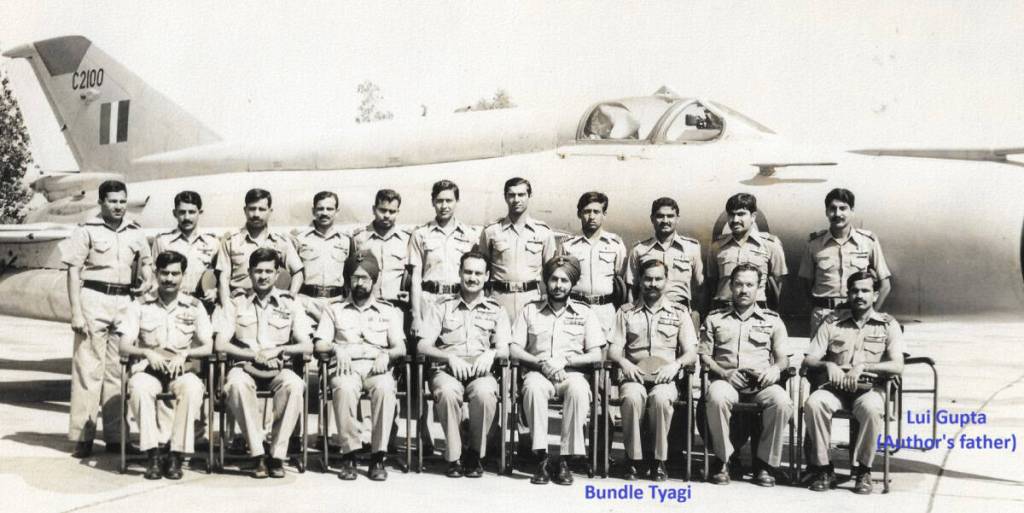
At Jaisalmer (1980), the squadron’s armament practice was so accurate that the command ran out of targets. The Pathankot achievement looks even more remarkable when you add 24 Oct 1978: an engine failure on landing led to a runway crash and fire. He suffered spinal compression fractures, burns to the shoulder, and knee/elbow injuries, and was medically grounded for seven months—then returned to tempo and finished the tour on a surge.
The Desert Mission
Posted to the Aircrew Examination Board (Hindon), he added just 86 hours in a year. With fifteen years of re-equipment behind the IAF, the juggernaut should have slowed. Instead, another door opened, one that led to the desert sands of Iraq.
In October 1981, Bundle was selected as a MiG-21 instructor with No. 17 Squadron, Iraqi Air Force, based at the remote H-3 airfield. He arrived with approximately 2,200 hours, taught Iraqi pilots for two years, and added another 445 hours to his logbook. It was as if fate had ordained that he would champion the Fishbed not just across Indian skies, but across borders, sharing its secrets with pilots who might never fully understand the machine’s temperament the way he did.

Returning to India in late 1983, Bundle had done something almost unthinkable in the modern Air Force: reached nearly 20 years of service without a single staff college course or desk posting. Every assignment had been operational, every posting had meant more time in the cockpit.
Command and the Final Sprint
On return, he went to his first desk job at HQ Eastern Air Command—and still “stole” 13 hours on the MiG-21. In July 1984, he joined No. 35 Squadron, Bareilly (special ops/EW, Type-96), taking over as its Commanding Officer. It was brief—six months as the command of the unit was upgraded to a Group Captain and he was posted out, but he still flew ~95 hours.
The big command came on New Year’s Eve 1984/85—a fitting moment for a man whose career had been defined by dramatic timing. No. 32 Squadron was converting from the Su-7 to MiG-21bis and moving to Jodhpur. Bundle arrived as commanding officer with 2,806 MiG-21 hours already in his logbook.

The squadron faced teething troubles, but Bundle’s philosophy was simple: lead from the front, fly as a squadron more than anyone else, and solve problems in the air rather than in conference rooms. By the time he handed over command in July 1986, he had added 442 hours in that single posting—a pace that would exhaust most commanding officers.
At 3,250 hours, many would have considered their MiG-21 journey complete. He didn’t.
A helmet in the office
After 1986, the appointments on his nameplate got bigger while the cockpit time, in theory, should have shrunk. Three years with Air Staff Inspection—a tour not famous for flying—still yielded 189 hours through disciplined currency and judicious scheduling. Then came the sequence that would have ended most pilots’ flying: COO, Jamnagar; Station Commander, Naliya; and later AOC, Jamnagar. Jamnagar, however, was a hive of MiG-21 activity—TACDE included—and Tyagi treated that not as background noise but as a resource.
His rule was simple and public: “If an air test sortie is delayed, call me.” He kept his helmet in the office, not as décor but as intent. Test flights, post-servicing checks, the dull but essential sorties that keep fleets honest—he took them, flew them to standard, and handed the aeroplanes back to the unit. Across seven years in those senior roles, he added 564 hours of experience in that type.

The image is perfect: a senior officer, responsible for entire air bases and multiple squadrons, with his helmet sitting in the corner of his administrative office like a reminder of what really mattered.
The Science of Excellence
Tyagi’s flying distilled to two articles of faith: energy management and angle-of-attack discipline. The MiG-21, treated precisely, would do things that surprised even its friends. It would loop from ~400 km/h, and it would “barrel” safely at ~280 km/h—provided hands were calm and the nose was allowed to fly clean. On 5 December 1971, he took that discipline to its theatrical edge. He looped over Dacca during a S’neep mission, after earlier loops over Kurmitola, not for bravado, but to prove a point about margins honestly earned.

In set-piece fights he was clinical about constraints and advantages. Against the Mirage 2000 under Magic-I rules, he used his favourite “Bagli” manoeuvre—get into the armpit, deny space near the near-kill boundary (≈530 m), and force the fight where the Mirage’s missile cues and sight picture were least comfortable. Flown correctly, the MiG-21 stayed safe and even put both Mirages in the gunsight. Against the MiG-29 at Pune, he twice won by surprise; by the third engagement, with surprise gone, he called it straight—in a fair fight, the MiG-29 is superior. The lesson was realism: fly to your jet’s strengths, respect the other fellow’s, and the older aeroplane still has bite.
What the MiG-21 taught him was simple and hard. Modesty: Stay humble. Flexibility: operate from ~280 km/h to ~2,400 km/h, and from ground level to ~25 km (he notes the world altitude record is 34 km). Adaptability: the quickest role change—air defence ↔ strike—and rapid turn-around. The MiG-21 doesn’t forgive mishandling; it forces calm, knowledge, and precise control—leadership under pressure. His line to youngsters was fierce and disarming at once: “Until you’re blown out of the sky, you still have a chance—because you fly one of the best fighters ever built.” He also called the cockpit “a mother’s womb—the safest”—provided you behaved with your machine.

Anecdotes: weather, routes, and the room for judgment
Ferries in the weather. In July 1977, posted to 21 Squadron (Poona), he ferried the first MiG-21bis for 26 Squadron from Ozar north. The clearance took days; the monsoon didn’t. They launched into a continuous white wall, flew a quiet vertical split on the Mandsaur NDB, and spent over an hour with no radar painting them while Palam, Hindon, Ambala, Halwara, and Adampur all reported embedded CBs. They broke out over the Ganges near Garhmukteshwar, diverted to Bareilly, burned to landing weight, and rolled in. The “welcome” was a close arrest—then phone calls, and a handshake from CAS Moolgavkar: “Well done, my boy.” The practical outcome was small but lasting: en route, radars would be manned for fighter ferries.
Precision on a public stage. Tilpat, 1975. After rehearsals at Sidhwankhas, a four-ship fired 32 rockets at the Delhi demonstration. A message from CAS Moolgavkar, naming the No. 2 ( Bundle Tyagi) : all 32 had walked into the tank’s hull.
Kalaikunda, 3 Apr 1980, this was repeated. The Detachment arrived by afternoon; one dummy run pinned the targets. At first light, four jets loaded 32 rockets each, flew the profile, and returned. A letter from AOC ‘Rusty’ Sinha singled out the cluster—rockets looked as if they walked into one another—public praise, private satisfaction.

Speed and the airspace beyond the cockpit. From 7 Squadron (Chandigarh), he once ferried Kanpur→Jamnagar for TACDE—air-test, Jodhpur turn-around, then westbound at seven kilometres. Fuel-rich near Ahmedabad, he descended to five kilometres and slipped supersonic for a short spell, then recovered at Jamnagar. The boom hit a city already on edge; panic followed. He was told—gently but firmly—to disappear, went home on leave, and returned a week later to a measured scolding.
Borders and discipline. Srinagar, 1972. A valley-flying check with Flt Lt J. J. Williams turned the wrong way near Poonch, skipping briefly across the line over a small strip with a white UN aircraft. They corrected, answered questions, and got a fair caution—followed the next afternoon by another, when an enthusiastic 270° peel-off at rejoin drew the old line: “Don’t teach me flying, kid; your milk teeth are still there.” He recollects an IAF that was accepting of error and humour.
Tempo and the team behind the numbers. Pathankot, 26 Squadron. He flew 34 sorties in the first two weeks, then helped knit a mixed intake of laterals from Marut, Gnat, Hunter, Sukhoi. Three fighter squadrons shared a small local area in Pathankot on a rotating one-hour block; he and one other officer would sprint to ATC while the other flew with trainee pilots to max time, then swap and repeat. When the other units detached to Jamnagar, the sky opened: they briefed for 60 sorties (0700–1330) and flew 61 by 1335, one go-around for birds costing a friendly wager—24 bottles of rum for the ground crew. Looking back, he credited the Warriors—maintenance, ops, and a younger lot willing to fly whenever asked.
The Final Tally
December 1996. Thirty-one years after he joined and twenty-eight after his first MiG-21 sortie, Tyagi closed the book on 6,318 sorties and 4,003:45 hours—almost a textbook ~40 minutes per sortie. The arithmetic is astonishing; the architecture behind it is greater. He didn’t just accrue hours—he built capacity: personally helping convert five squadrons (3, 7, 17, 21, 26) to the Fishbed and turning pilots into fully operational fighter pilots, day and night.

Those who flew with him remember the man as much as the numbers: soft-spoken, the famous moustache disguising a gentler self; meticulous, with logbooks written in near-calligraphy that made maintenance chiefs smile. The ledger proves endurance; the ledger’s margins show standards.
Today, as the MiG-21 approaches its farewell from Indian service after more than six decades, there’s a simple wish echoing through the aviation community: let the man who knew her best, who loved her longest, who flew her highest—let Bundle Tyagi bid farewell to the Fishbed one last time, up close, where legends belong.
After all, some love stories deserve a proper ending.


Leave a Reply