
The helicopter lurched violently as its engine failed, the acrid smell of burning oil filling the cockpit. Below, Chinese troops advanced across the Himalayan valley floor. In this moment of crisis—trapped in a disabled Mi-4 helicopter in hostile territory—Squadron Leader Surya Kant Badhwar made the split-second decisions that would later earn him the Vir Chakra.
This extraordinary act of courage was just one chapter in a life that has spanned continents, survived wars, and transcended cultural boundaries—a journey that began in pre-partition India and continues today along the peaceful shores of Lake Erie in Canada.
Echoes of a Lost Empire
Surya Kant Badhwar was born on July 7, 1930, in Purana Pech, Hansi, in Haryana’s Hissar district—the youngest of three children of Shrikrishan Lal Badhwar and Prakash Vati Kapoor.
He came from the once-prominent Badhwar family, direct descendants of Rai Nagar Mall Badhwar (1815–1871), a cotton magnate and philanthropist whose legacy adorned civic institutions across Punjab and the United Provinces. The family’s stature grew under his son, Rai Gopi Mall, who built schools and serais and donated generously to institutions like DAV College, Lahore.
By the early 1900s, the Badhwars had business interests across Punjab, Lahore, Moradabad, and Budaun. But a failed post-war venture in Liverpool in 1922–23 shattered their fortunes. Surya’s grandfather, Mohan Lal Badhwar, was forced to dissolve their thriving enterprise.
Surya’s father, Shrikrishan Lal, responded with resolve—working multiple jobs. As circumstances shifted, Surya and his elder brother, Kamal, were sent to live with their uncle, Jagatjit Badhwar, an employee at Philips in Rawalpindi. At the same time, their sister, Lavang Lata, was cared for by an aunt who served as a headmistress. Despite these separations, the family remained closely knit. By 1940, the family reunited in Lahore, living in a vibrant household typical of Indian joint families—three generations sharing one roof, their collective resilience forming the bedrock of young Surya’s character.

Winds of Change
The 1940s brought both global turmoil and personal transformation. World War II forced multinational companies like Philips to scale back operations in the subcontinent, pushing many male family members—including Surya’s father and uncle—to join the armed forces. While some enlisted in the Army, Shrikrishan Lal and Jagatjit Singh chose the skies, joining the Indian Air Force

In 1947, as the subcontinent convulsed with Partition, the Badhwars relocated to Delhi amid growing unrest. Their Lahore home vanished overnight, making them refugees in a newly divided land. For Surya, now living in Inter-service accommodations at King Edward Hostel, life was marked by mess hall meals, cricket matches with fellow service children, and distant bugle calls. Watching his father—always composed, always dignified—Surya knew his destiny lay in the clouds.
Taking Flight
In July 1948, as a newly independent India was finding its footing, Surya Kant Badhwar answered the call of the skies. He carried forward his father’s passion for aviation and joined 88 fellow cadets reporting for the 53rd Pilot Course at the Initial Training Wing in Coimbatore.
The journey to Coimbatore itself foreshadowed the challenges ahead. The Hyderabad Police Action was in full swing, and trains from northern India were rerouted through convoluted detours. A straightforward trip from Delhi became an exhausting three-day odyssey. The ongoing Kashmir conflict had diverted many of the IAF’s Harvard trainers into operational service. As a result, Badhwar and his peers underwent an extended ground training regimen, spending a full year at Coimbatore. It wasn’t until July 1949 that they finally transferred to No. 2 Air Force Academy in Jodhpur to begin flying training.
In Jodhpur’s clear desert skies, Badhwar first conquered the nimble Tiger Moth before advancing to the more powerful Harvard as these aircraft gradually returned from frontline duties. The fourteen-month program was brutally selective—by its conclusion in October 1950, fewer than half of the original cadets remained, with Badhwar among the 40 who earned their wings and commissions.

Selected for the fighter stream, Badhwar’s next stop was the Conversion and Training Unit at Ambala. Here, he converted to the storied Supermarine Spitfire and the formidable Hawker Tempest—legendary aircraft that had shaped the outcome of World War II.
In May 1951, he joined the elite No. 8 Squadron at Palam. The unit had recently transitioned to the de Havilland Vampire—India’s first operational jet fighter. For Badhwar, it was another leap forward. From piston-engine legends to jet-age pioneers, he adapted quickly. He served with No. 8 Squadron until the end of 1952, when a new chapter beckoned.
Badhwars in the IAF
Surya’s path wasn’t solitary; the Badhwar name wove a thread through the IAF’s fabric. Across generations, the Badhwars carved a remarkable tradition in military aviation. From transport missions to daring bombing runs, their service blended grit, skill, and a quiet pride that echoed through the ranks.
His cousin and coursemate Nittript “Niti” Lal Badhwar chose the transport stream. He eventually commanded No. 25 Squadron and served as Air Advisor Indian High Commision in Pakistan, earning the Ati Vishisht Seva Medal for his excellence.
Second cousin Ravinder Lal Badhwar from the 58th Pilot Course commanded multiple fighter squadrons, including during the 1965 and 1971 Wars, and only recently passed at 93 in 2023.
Perhaps the most decorated among them was his father’s cousin brother Krishan Kumar Badhwar, who led daring bombing missions as commanding officer of No. 35 Squadron during the 1971 war. Flying Canberra bombers deep into enemy territory, he earned the Vir Chakra, the AVSM, and a Bar to the AVSM before retiring as an Air Commodore.
Praveen Badhwar, son of Jagatjit, became a transport pilot with the 85th Pilot Course. He later earned a reputation as a beloved flying instructor and retired as the Deputy Commandant of the Air Force Academy.

Through generations and branches, the Badhwars represented a quiet continuity of excellence within the Indian Air Force—each contributing their chapter to a shared and storied legacy in blue.
Instructor and Mentor
In October 1952, Surya’s skill and calm authority earned him a spot at the 11th Flying Instructors Course in Ambala. He thrived as a trainee teacher and was posted to the Air Force College at Begumpet and the Conversion Training Unit at Secunderabad. Guiding cadets through Tiger Moths, Harvards, and Vampires, he instilled precision and confidence, his steady hand a reassurance in the cockpit.
A personal milestone arrived in 1954. On leave in Bombay, Surya met Dionne (Indira later) Fernandez through a family connection—his mother’s friendship with Dionne’s sister Monica. Seeking a dance partner for an Air Force Ball, he found more than he’d bargained for. Dionne, graceful and spirited, matched him step for step on the dance floor. Their courtship paused when she left for England, but in 1957, his posting to the UK for training reunited them. He proposed under foreign skies, and they married upon returning to India at Bombay’s Taj Mahal Hotel—a union that has endured over six decades. Her brother, Charles David Fernandez, an IAF officer from the 51/52 Pilot Course, tied their families closer to the service.
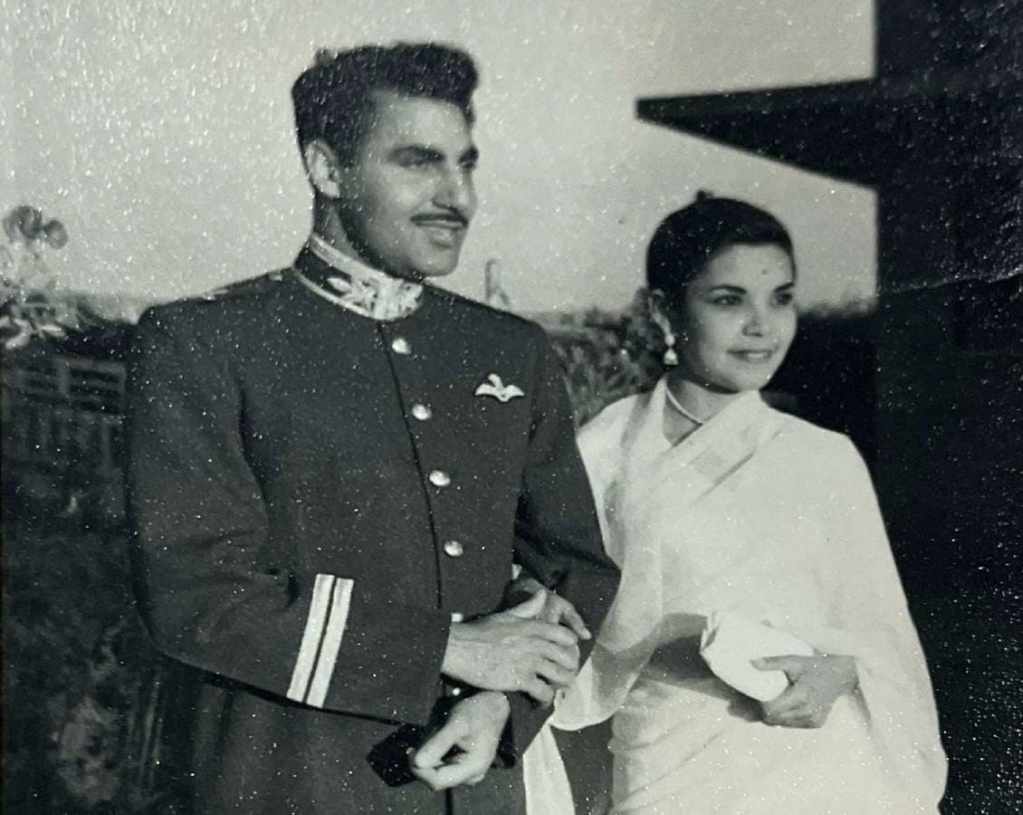
Professionally, Surya’s star climbed. In 1956, he became Staff Officer to Air Commodore Arjan Singh, a towering figure who’d later become Marshal of the Air Force. Their bond grew beyond duty—Surya introduced Singh to golf, a pastime that became the Marshal’s passion. Flying dual Vampire sorties, Surya’s airmanship dazzled Singh, who recommended him for the Canberra bomber fleet that IAF was acquiring, a career-defining move.
Triumph, Turbulence, and Tenacity
In February 1957, Surya stood on the rain-slicked tarmac of RAF Bassingbourn in the United Kingdom. He had been hand-picked to train on the Canberra bomber, particularly in its photo-reconnaissance role. After months of intensive preparation, he returned to India and joined the No. 106 Strategic Reconnaissance Unit at Agra as its formtive member.

Then, in March 1959, disaster struck. During a routine training flight, his Canberra exhibited an alarming wing drop during the take-off run. The aircraft shuddered violently as warning lights flashed across the instrument panel like angry fireflies. Drawing on his training and instinct, Badhwar took immediate corrective action, aborting the take-off and bringing the damaged aircraft to a halt.
Surya was convinced, backed by the engineering team, that the cause was a mechanical failure, not pilot error. However, despite the facts—and perhaps due to the high cost of the newly acquired aircraft he was held responsible. A senior officer sympathetic to his situation offered him a dignified exit from the situation if he accepted guilt. But, unwavering in his principles, Surya Kant Badhwar refused to admit fault for something he hadn’t done. The unit’s engineering officer testified that the brakes were fully applied and burnt out from emergency procedures—yet the verdict still went against him.

Transferred to No. 11 Signal Unit in Jodhpur in June 1959, he swapped flight controls for radar screens. Lesser men might have faltered, but Surya rebuilt. His commitment never wavered. In June 1961, he was promoted to Squadron Leader and selected for helicopter conversion training in Kirovohrad, USSR. This marked his triumphant return to operational flying and confirmed the Air Force’s enduring faith in his abilities despite earlier setbacks.
On his return from the USSR, he was briefly attached to the 109 Helicopter Unit for conversion and, in August 1962, took over command of No. 107 Helicopter Unit in Leh —a rugged proving ground at 11,500 feet.
Flying into the Fire
Leh in 1962 was a frontier outpost—wooden huts warmed by makeshift stoves, a precarious airstrip carved into the Himalayas. Summer blazed at 40°C, and winter plummeted to -40°C. Surya’s team of seven pilots flew Soviet Mi-4s—sturdy but ill-suited to such altitudes. This was Leh in 1962—what the IAF euphemistically called a “forward area.”
These men were part of a new breed in the Indian Air Force. Around 1960, as Mi-4s began entering service, the first batch of pilots—drawn from both fighter and transport streams—along with engineers and airmen, had been sent to the Soviet Union for conversion training. Between 1961 and 1963, three large batches followed, enabling the rapid growth of the helicopter stream. Mi-4s were assembled at Chandigarh and Alouettes at Kanpur, supported by two specialised Mi-4 engineering teams trained in Russia. Mi-4 units like 104, 105, 107, 109, 110, 111, and 112 HU were quickly converted and seeded by these very pioneers.

When a United States Air Force delegation visited Leh, they watched in disbelief as the Indians coaxed performance from the helicopters that defied their operational specifications. “They’re either bloody fools or exceptional pilots,” one American officer remarked. The truth was simpler: it was all they had—and they made it work.
Four of those seven would go on to earn decorations for gallantry.
The Galwan Mission
The Sino-Indian War of 1962 transformed their already dangerous flying into something more perilous. On October 4, as tensions escalated, Badhwar received urgent orders to evacuate 1/8 Gurkhas being replaced by the 5th Battalion of the Jat Regiment, a strategic post under imminent threat.
Flying with Flight Lieutenant K.R. “Kiddo” Narayanan, Badhwar approached the Galwan area under hostile skies. Just as they prepared to depart after picking up the troops, the Mi-4 shuddered violently as the engine failed. Below, Chinese troops were already visible on the ridgeline.
With remarkable presence of mind, Badhwar feigned an injury and approached the advancing Chinese soldiers under a white flag. He attempted to buy time using halting English and hand gestures while Narayanan worked frantically to restart the stalled engine.

When negotiations failed, Badhwar made a desperate dash back to the helicopter under a hail of bullets. Narayanan had already engaged the rotors, creating a providential dust cloud that obscured the enemy’s aim. Limping dramatically from his staged injury, Badhwar leapt aboard as the helicopter lifted unsteadily into the air.
Though they made it to Galwan, they faced further mechanical issues. Another pilot, Flight Lieutenant Sinha, evacuated them to Chushul under equally hazardous conditions.
For this extraordinary courage and other actions during the conflict, President S. Radhakrishnan presented Badhwar with the Vir Chakra in 1963—a recognition of valour.

Post War Service
After the 1962 war, Surya Kant Badhwar continued to lead the 107 Helicopter Unit at Leh until the summer of 1964. His next major assignment took him to Allahabad, where he served as instructor and unit commander at the Logistics Support Training Unit (LSTU), the sole unit entrusted with training pilots on Helicopters equipped with the Bell G3s.

By 1966, his reputation for thoroughness and integrity earned him promotion to Wing Commander and a posting to Air Headquarters. There, Air Commodore Anantnarayan selected him as Deputy Director of Works, where he supported efforts to strengthen the IAF’s infrastructure, ensuring that bases across the country could sustain operations under various threat scenarios.
Later that year, Badhwar returned to the Soviet Union, heading the Camouflage Training Unit. From 1966 to 1970, he led Indian efforts to enhance battlefield survivability through visual concealment and deception—adapting Soviet techniques to Indian conditions and developing new ones suited to the subcontinent’s varied terrain. His final six months in uniform were spent at Operational Command.

As retirement approached, Badhwar stood at a crossroads: pursue a stable career flying large transport aircraft—perhaps with Air India—or move to the dynamic world of private civil aviation, with its smaller helicopters and ever-changing missions. For a man drawn to challenge, the decision was clear. Helicopters beckoned.
Transition to Civil Aviation
Joining Cambata Aviation as Director of Operations in 1971, Surya embraced an astonishing variety of flying assignments: training naval officers in the morning, crop spraying over sprawling farmlands by midday, ferrying government ministers in the afternoon, and occasionally choreographing aerial scenes for Bollywood productions.
Films like “Janwaar Aur Insaan” and “Roop Tera Mastana” featured flying sequences orchestrated and executed by him. The precision required for camera shots was its art form—distinct from the technical routine of other missions but no less demanding.

For his daughter Natasha, born in February 1964, those years were magical. Her father’s work meant occasional visits to movie sets, where stars like Mumtaz, Jeetendra, Pran, and Danny Denzongpa would ruffle her hair and slip her candies between takes. Natasha began flight training later in life, hoping to one day fly her father—a quiet tribute to the man who taught her to look up.
By the mid-1970s, however, India’s helicopter companies began to struggle. Fleets dwindled, and opportunities narrowed. Sensing change, Surya looked abroad.
A New Beginning in Canada
“And what will you do in Canada, Mr. Badhwar?” the immigration officer at Toronto Pearson International Airport asked without looking up.
“I’ll do whatever is necessary,” came the quiet, confident reply.
It was 1974, and at 44, Surya Kant Badhwar stood on the threshold of reinvention. With him were Indira, his partner of nearly two decades, their spirited daughter Natasha, their teenage son Nitin, and a mere $32 folded into his pocket. A decorated Wing Commander and veteran aviator, he left behind a full career and a very comfortable life in India for an unfamiliar land. The decision baffled peers—Australia or the United Kingdom, with their ready networks of ex-IAF officers, promised easier landings.
Toronto welcomed the Badhwars with snow-covered streets and unfamiliar customs. Yet, from the start, both Surya and Indira found work. She had built a career in India with the Oberoi and Sheraton Hotels, experience that landed her a position with Sheraton in Toronto before she eventually joined the Royal Bank of Canada. Surya, too, began at Sheraton—waiting patiently for an opportunity to fly again.

But the Canada of the 1970s bore its own shadows. Prejudice lingered in the air like a stubborn fog, and despite his impeccable record—thousands of hours on everything from Tiger Moths to Canberras—Surya’s wings were clipped. Requalification demanded a gauntlet of costly retraining, an impossible hurdle for a man supporting a young family on modest means. Another might have buckled, but Surya’s spirit was forged in tougher fires.
With the same resolve that once guided him through Himalayan blizzards, he pivoted. Enrolling in an accounting (CGA) course, he traded altimeters for ledgers, sortie logs for balance sheets. The transition was jarring—numbers on paper lacked the roar of engines or the rush of ascent—but Surya approached it with a soldier’s discipline. Joining the Metropolitan Toronto Police Service in a civilian role, he brought his quiet integrity to their administrative ranks. By the early 1990s, he’d risen to Paymaster—overseeing the finances of one of Canada’s most respected institutions with a steady hand.
When he retired in July 1995 at 65, Surya Kant Badhwar had sculpted something extraordinary: two distinct careers, continents apart, each marked by excellence. From the IAF’s forward bases to Toronto’s civic corridors, he left every institution stronger.
An Active and Fulfilling Retirement
Now 95, Surya and Indira, married over 66 years, live on Lake Erie’s north shore—a haven of family and nature. They’ve travelled widely, their curiosity undimmed. Natasha and son-in-law Anthony, son Nitin and wife Judy, and granddaughters Taylor and Cierra anchor their Canadian lives.

The skies still stir him. His eyes sparkle at the hum of rotors or a tailfin’s glint. Among the countless flights of his career, three moments stand as pillars. The first unfurled in 1950, a training run in a Tiger Moth gone awry when the engine over-revved, threatening a fiery plunge. With a rookie’s calm belying his 20 years, he cut the power at precisely the right altitude, gliding the fragile craft to a flawless landing. His Chief Flying Instructor’s nod of respect that day lingered longer than any medal.
The second bloomed in 1957, when a posting to England for Canberra training rekindled his romance with Indira. Their connection, sparked years earlier over dance steps, flared anew as if time had paused. “Our bond was undeniable,” Indira recalls with a smile, “and the rest, as they say, is history.”
The third, etched in 1962’s Galwan mission, earned him the Vir Chakra—and forged an unbreakable tie with Flight Lieutenant “Kiddo” Narayanan. Together, they defied bullets and a failing Mi-4 to save Gurkha troops, their trust a lifeline in chaos. Kiddo’s later death in a Marut test flight struck Surya like a silent thunderclap, a loss borne with the dignity of a man who’d seen too much to falter.

Those who knew him in uniform recall more than skill. Air Marshal Vir Narain, a coursemate from the 53rd Pilot Course, paints him as “handsome and suave,” a debonair figure in the mess hall. Air Commodore T.K. Sen captures his soul: “Suraj Badhwar—sunshine—was a gentle spirit,” his warmth a steady glow amid the IAF’s storms.
Today, from his lakeside home, Surya Kant Badhwar can trace the arc of nearly a century through his own extraordinary life—from the trauma of Partition to the tensions of the Cold War, from training on Tiger Moths to directing operations in jet-age bombers, from ballroom dance floors to battlefields, from rejection in a foreign land to reinvention with dignity.
The medals in his study tell part of the story. But the truest measure of this remarkable man lies in the lives he’s touched, his embodied values, and the love that has sustained him—through war and peace, hardship and triumph.

I am grateful to Wg Cdr Ravi Mani for connecting me with Surya Kant Badhwar’s daughter Natasha, who patiently helped out to support this endeavour.
⭐ This post previously received 5.0/5 from 134 readers in our legacy system.


Leave a Reply