

The distinctive numbering of the Helicopter Units in the Indian Air Force, assigned in the 100 series (such as the No. 105 Helicopter Unit), has always piqued curiosity, standing in sharp contrast to the sequential numbering of Fighter and Transport units, which begins with No. 1 Squadron. This peculiarity served as a gateway to an intriguing exploration of the IAF’s helicopter fleet – IAF’s embrace of helicopters was largely accidental. This essay delves into the fascinating journey of the IAF’s “chopper fleet,” exploring how this accident became a vital backbone of the force.
Thank You, Navy
The Indian Navy’s vision for an aircraft carrier fleet sparked the unexpected romance between the Indian Air Force and helicopters. The Naval Aviation Directorate recognised the need for air-sea rescue helicopters, and when a single helicopter solution was chosen for all three services, the proven S-55, used by all branches of the US military in Korea, stood out.
Enter Air Marshal Gerald Gibbs, the then-Chief of the Air Staff. Despite initial IAF disinterest, Gibbs, in October 1953, agreed to a unique proposal from Naval Chief Admiral Pizey of the Navy. The IAF would take temporary custody of the S-55s, deploy its pilots and technicians to induct the first military helicopter in India, and eventually transfer them to the Navy after training their personnel.
The IAF hurriedly selected a core team: Flight Lieutenants SK Majumdar and Allison Neil Todd (pilots), Flying Officer K.K. Mitra (engineer), and technicians Flight Sergeant Rawat and Sergeant Sharma. This team would travel to the US for S-55 conversion training and form the nucleus of the 104 Helicopter Flight at Palam. The training reflected the joint nature of the mission. Pilots underwent “wet winching” training for air-sea rescue operations, aligning with the Navy’s needs.

This decision by Gibbs proved pivotal. While honouring their commitment to training the Navy, the resourceful crew of the 104 Helicopter Flight discovered the helicopter’s true potential during the 1950s. These versatile machines excelled in casualty evacuation, disaster relief, VIP transport, and reconnaissance flights in remote areas. Their exploits earned them praise, particularly during the Jamuna River flood relief, where a newspaper dubbed them “Aapatsu Mitram” – “friend in times of distress,” a motto adopted by helicopter units for decades to come.
However, the IAF’s newfound enthusiasm for helicopters faced two significant hurdles: funding limitations and the ancillary status of helicopter squadrons, which meant they weren’t included in the authorised squadron strength.
Ancillary Unit!
Following the asset division during India’s 1947 partition, the Indian armed forces faced a rebuilding challenge. The Indian Navy yearned for multiple aircraft carriers, while the Army aimed to expand its Auster Aircraft Observation Post (AOP) aircraft fleet. The Indian Air Force, meanwhile, prioritized bolstering its fighter and bomber squadrons to the approved strength of at least 15 Squadrons.
In a crucial budget-driven decision, the IAF was entrusted with fulfilling the aviation needs of all three branches. This meant the IAF initially viewed helicopters as an “ancillary” unit to provide air logistics for the Army and Navy (later including paramilitary forces). This mirrored the established system for ancillary units like the 101 PR Flight, formed in 1949 for aerial photography, which operated outside the core squadron structure. Reflecting this, the IAF assigned helicopters a distinct numbering system, starting with 104 Helicopter Flight. This “100 series” numbering continues today, underlining their separate status from the mainstream IAF squadrons.
BRO – the bro
While a handful of Bell-47Gs were added for training in the late 1950s, a more permanent and versatile helicopter force was needed. In a unique approach, a joint services committee opted for a two-pronged strategy, breaking away from the trend of a single helicopter type.
The workhorse S-55s remained the backbone for heavy lifting and flatland operations. Meanwhile, the nimble Alouette IIIs christened “Chetak” in Indian service, were chosen for their light utility roles at high altitudes. This selection proved invaluable during heightened tensions with China.

India’s “Forward Policy” aimed to establish outposts along the vast Himalayan border, a logistical nightmare due to the lack of roads. Fixed-wing transport offered some solutions, but helicopters became a game-changer. Their ability to operate in challenging terrain could revolutionise border logistics.
In 1959, a Soviet statement hinted at a potential Sino-Soviet rift. Capitalising on this diplomatic shift, India secured the first agreement with the Soviet Union for acquiring AN-12 aircraft and Mi-4 helicopters. The initial ten Mi-4s were acquired creatively. Funds allocated for road construction by the Border Roads Organisation (BRO) were used to finance the purchase through a commercial credit. Officially, these helicopters were for road building. However, a persistent rumour suggests that R.N. Kao, a prominent Indian intelligence figure, recognised the helicopters’ covert potential and was crucial in securing the funding. This theory is bolstered by the subsequent deployment of Mi-4s by the intelligence agency’s aviation wing established in 1963.
The acquisition of Mi-4s marked a turning point. With nearly 80 helicopters added over time, the Mi-4 fleet demonstrated helicopters’ transformative power. The Soviet model of offering affordable aircraft with extended credit terms paved the way for future Soviet helicopters to become the mainstay of the Indian Air Force’s helicopter fleet.
Himalayan Daredevilry
Deploying helicopters in Ladakh, Kashmir, and the Northeast was a formidable challenge. No existing helicopter had operated in such extreme conditions. IAF pilots had to become pioneers, learning and adapting on the fly.
The Mi-4s of 107 Helicopter Unit (HU) stationed in Leh exemplified this spirit. Inducted in 1960, they relocated to a makeshift base in Leh by May 1961 and serviced all of Ladakh. These daring pilots routinely flew well above their service ceilings, even landing at DBO, a staggering 16,600 feet above sea level. The frigid temperatures demanded unorthodox solutions. Mi-4 engines had to run periodically throughout the night to maintain operability. Without sufficient engine power, pilots developed a “roller take-offs and landings” technique at high altitudes. Additionally, they relied on local air thermals for additional lift while traversing ridges.
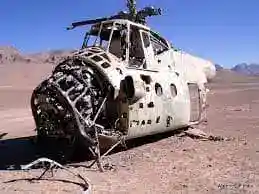
During the 1962 war, when DBO was abandoned, Mi-4s performed critical casualty evacuation missions. Landing on treacherous cliffs and ridges in the Shyok Valley amidst strong crosswinds showcased exceptional piloting skills. A poignant reminder of these efforts is a derelict Mi-4 at DBO, a testament to the risks these pilots faced, sometimes delivering supplies under enemy fire.
A similar story unfolded in Arunachal Pradesh, where helicopters tirelessly transported supplies, evacuated casualties, and airlifted troops, flying an impressive number of sorties. However, unforgiving terrain and enemy action claimed some pilots and helicopters.
By the war’s end, the IAF’s helicopter fleet had been forged in the crucible of the Himalayas. The period from 1954 to 1962 saw the emergence of some of Indian aviation’s finest pilots. Their bravery and ingenuity in developing Standard Operating Procedures (SOPs) for these challenging environments remains a remarkable and under-recognized achievement.

Logistics?
The 1962 war served as a wake-up call, highlighting the critical role of helicopters in high-altitude operations. The number of helicopter units grew to eight, with a dedicated unit, 114 HU, formed in 1964 to take over operations in Ladakh. Nicknamed the “Siachen Pioneers,” this unit, based in Leh ever since, has become the most decorated in the IAF. For over five decades, they’ve relied on agile helicopters like the Chetak, Cheetah, and currently, the Cheetal to sustain crucial missions in the harsh Himalayas.
To support the expanding fleet, the IAF made a significant change. Traditionally, pilots were categorised into fighters and transport. Until then, all Helicopter pilots in the IAF have been “converted” from the fighter or transport streams. A third stream—helicopters—was established, starting with the 83rd Pilot Course, commissioned in January 1963. A dedicated training unit, the Logistics Support Training Unit (LSTU), was also formed in December 1962. Recognising the growing importance of logistics, Air Headquarters even created a separate Directorate of Operations for Transport & Logistics the same year.

However, amidst this expansion, a crucial misstep occurred. The perception that helicopters were primarily for “logistics support” and “ancillary” units led to a neglected status for the fleet within the IAF. This underestimation defied reality—the helicopter pioneers were some of the IAF’s most skilled and dedicated personnel, handpicked to build this vital capability.
It wasn’t until 1995 that this Directorate was renamed Transport & Helicopters after the efforts of then Joint Director of Helicopter Operations – Fali Major. He would later became the first helicopter pilot to hold the appointment as Director Ops (T&H) and become the first and only IAF Chief from the helicopter fleet
Logistics goes Offensive
By the 1971 war, the IAF’s helicopter fleet had matured significantly. It had grown to eleven units, operating alongside a robust fixed-wing force of around forty squadrons. More importantly, helicopters had transitioned from purely logistical roles to vital offensive roles supporting ground troops.
Initially, budget constraints and a focus on utility limited the IAF’s vision for helicopters. This led to the rejection of the armed Mi-4 variant despite its potential for offensive firepower. However, the sight of Chinese forces attacking unarmed IAF helicopters during the 1962 war served as a harsh lesson.
The IAF responded with characteristic ingenuity. Between 1962 and 1965, engineers devised a clever solution. They repurposed .50-caliber Browning machine guns from B-24 Liberator bombers and mounted them on Mi-4s under the fuselage. This innovative modification birthed the IAF’s first offensive helicopter capability, enabling bombing and strafing attacks.
This newfound capability was put to the test during the 1965 war. A dedicated helicopter task force comprising units from 107, 109, and 111 HUs directly supported the army in Chandigarh, Jammu, and Srinagar. These helicopters revolutionised battlefield tactics by airlifting supplies and engaging enemy positions with their newly acquired firepower. This innovative tactic resulted in a successful 79 offensive helicopter sorties during the war, marking the arrival of the armed helicopter era in the IAF. This paved the way for acquiring more modern attack helicopters like the Mi-25/35 in the 1980s and the Apaches recently with unique command and control structures to reflect the IAF’s commitment to jointness.

Arunachal steps-in big time
Introducing Mi-8 helicopters marked a significant leap for the IAF, afforded again by the Soviets offering long-term credit. Compared to the workhorse Mi-4s, the Mi-8s boasted advanced technology, including powerful twin-turbine engines, that offered superior capabilities. The cost-effectiveness of acquiring them from the Soviet Union sealed the deal. Following successful evaluation in Arunachal Pradesh (formerly NEFA) in 1969, the IAF procured 36 Mi-8s for two new units (118 HU & 119 HU). These helicopters rapidly replaced ageing transport aircraft for crucial air maintenance tasks in the Eastern and Western sectors. By the late 1980s, the Mi-4s were phased out entirely.
The need for robust air support extended beyond the military. Recognising this, the then Union Territory of Arunachal Pradesh made a groundbreaking move in the early 1980s. They offered to fund two squadrons’ worth of Mi-17 helicopters (20 Numbers!), with the IAF providing logistical support for civilian needs like transportation and supply drops. This innovative initiative led to the formation of 127 HU and 128 HU (1985-86) and the introduction of the Mi-17s for the first time in the IAF. The Mohanbari airbase was also upgraded for helicopter operations using these same funds.

However, in an ironic twist, Arunachal Pradesh achieved statehood around the same time. This sparked a lengthy financial dispute between the Central Home Ministry and the new state government. The crux of the issue was who would bear the upfront and maintenance costs of the Mi-17s. Caught in the middle, the IAF faced funding challenges that hampered maintenance and other crucial operations.
This innovative funding arrangement wasn’t unique to Arunachal Pradesh. Numerous agencies, such as the Border Security Force (BSF) and the Survey of India, contributed smaller amounts over the years. Despite such hurdles, the IAF remained committed to its mission. However, the Arunachal Pradesh episode exemplifies the challenges of the IAF’s helicopter fleet in securing consistent funding and a future.

Summary
The IAF’s helicopter fleet has earned its reputation as a true force multiplier. These versatile machines tackle every conceivable task, from operating in the harshest terrains within India’s borders to undertaking missions abroad. They are the first responders in disaster relief situations, stepping in when other resources are unavailable. Unsurprisingly, the IAF’s helicopter fleet boasts the highest number of gallantry awards, a testament to the courage and skill of its crews.
There are now forty-odd Helicopter units in the Indian Air Force, nearly as many as the Fixed Wing capability—a remarkable feat for a fleet born out of accident and raised amongst severe challenges. Through countless hours of dedicated service by pilots and technicians, the helicopter fleet has earned its rightful place as a vital arm of the IAF and is no longer an “ancillary” fleet.
⭐ This post previously received 4.9/5 from 24 readers in our legacy system.


Leave a Reply