

In the annals of Indian Air Force history, few stories burn as bright yet remain as hidden as that of Group Captain Virendra Singh “Pat” Pathania. In 1965, he etched his name in history as the first IAF pilot to score a confirmed air-to-air kill after independence. But fate wasn’t done with this warrior-prince – six years later, the skies over Srinagar would again echo with the thunder of his Gnat fighter as he duelled Pakistani Sabres in yet another war. Today, while his Vir Chakra gathers dust, this tale of a royal who chose to fly in the clouds over the olive greens remains largely unknown.
The Royal Warrior’s Beginning
Born into the royal family of Nurpur on November 6, 1937, at Rey in Kangra, Virendra Singh Pathania emerged from a lineage where warrior blood ran deep. Known affectionately as “Bhoti” to his close friends, he was the son of Thakur Panjab Singh Pathania and Thakurani Sulochana Pathania – nobles who carried forward a distinguished heritage of military service. Yet even as a child, young Virendra’s dreams would take an unexpected turn skyward, away from the army boots his ancestors had worn for generations.

His early years were shaped by the winds of change sweeping through the subcontinent. The tumult of Partition in 1947-48 forced him from the halls of Burnhall School in Srinagar back to his hometown, where he continued his education at Government Middle School Rey, Aghar. Later, in the hills of Dharamsala, where he pursued his higher secondary education, a new passion took flight. Watching aircraft slice through the valley skies, the young royal found his true calling – one that would eventually reshape Indian military history.

The decision to join the Air Force rather than the Army raised eyebrows within his family, where military service traditionally meant ground forces. When Pathania cleared the Joint Services Wing entrance examination, now known as the National Defence Academy, family elders attempted to dissuade him from his chosen path. However, displaying the same determination that would later characterise his military career, Pathania remained steadfast in his decision to pursue his dreams of flight.
Formative years in the IAF
He joined the 10th Course of JSW at Clement Town, Dehradun, where he quickly established himself as a disciplined and focused cadet. Commissioned into the Indian Air Force in August 1956 with the 69th Pilot Course, Pathania’s early career saw him serving primarily with No. 23 and No. 17 Squadrons. Between 1957 and 1959, he cut his teeth at Poona on the de Havilland Vampire, one of the IAF’s early jet fighters. As India entered the supersonic era, Pathania transitioned to the Hawker Hunter, spending four years flying this advanced aircraft from bases in Poona, Kalaikunda, and Bagdogra. These postings allowed him to develop a well-rounded operational skillset, including escort missions and ground attack roles. His early years in the cockpit showcased his natural flying talent, earning him a reputation for being methodical, precise, and fearless in combat.

Apart from his love for flying, Pathania developed a deep fascination for automobiles. He was highly adept at repairing and maintaining vehicles, a skill that would stay with him for life. The first thing he bought after his commissioning was a Vauxhall 12-4 (1946 model), which he drove from Poona to Kangra. Remarkably, this car remains roadworthy even today, preserved within the family as a treasured heirloom.

By 1963, his growing expertise and combat proficiency earned him selection for the Pilot Attack Instructor (PAI) Course, India’s elite Top Gun program. He completed the 13th PAI course by the end of the year, refining his dogfighting skills, tactical acumen, and precision attack capabilities. This distinction placed him among the best fighter pilots in the country and paved the way for his return to No. 23 Squadron, where destiny had a more prominent role in store for him.

No. 23 Squadron, the IAF’s first unit to convert to the Folland Gnat, was stationed at Ambala under Wing Commander Bhopindra Singh, a highly experienced test pilot with significant expertise on the Gnat. Under his command, Pathania quickly adapted to the Gnat.
However, just as tensions with Pakistan escalated in mid-1965, Bhopindra Singh was posted out in July. Wing Commander Rags Raghavendran took over as CO of No. 23 Squadron for the second time. The squadron needed experienced leaders, and Pathania had already cemented his reputation as a dependable, skilled, and fearless pilot.
Raghavendran later recalled his trust in Pathania:
“One of the supreme imperatives of combat flying is that you must have utmost faith in your wingman’s capabilities. I had not flown with anybody in the squadron; the only person in the squadron during my previous tenure was Flt Lt ‘Pat’ Pathania. He had been a young but dependable flying officer when I had left the squadron, and he was now a senior flight lieutenant and designated leader of elements in his own right. But I told him that he was to be my Number 2 whenever I flew on a mission across the border.”
With war on the horizon, Pathania was poised to make history, and in the coming days, his skill and leadership would be tested in one of the most intense air battles in the subcontinent’s history.
1965 War: The First Confirmed Kill
Scheduled to be married on the day war was declared, he made the difficult decision to postpone his wedding, believing it would be unfair to his bride and her family to marry while the nation was at war. This choice exemplified his unwavering sense of duty—he promised to return and marry the same woman if he survived, a vow he would later fulfil with the Vir Chakra adorning his chest.

As hostilities commenced, Pathania was swiftly deployed to Halwara before moving to Pathankot, ironically the erstwhile capital of Nurpur state, as part of a Gnat detachment. Though seemingly outmatched against Pakistan’s sophisticated American-made F-86 Sabres and F-104 Starfighters, the Folland Gnat possessed advantages that would prove decisive—exceptional agility and manoeuvrability made it a formidable opponent in close combat.
During the war, Pathania’s operational logbook recorded a relentless series of missions: Mystere escorts, offensive sweeps, and combat air patrols over Chamb, Pathankot, and Akhnur. These missions placed him at the centre of some of the most intense aerial battles of the conflict.
The morning of September 3, 1965, marked a historic moment in Indian military aviation. Pathania participated in an unprecedented eight-Gnat formation tasked with escorting Mystere IV fighter-bombers. At 0700 hours, four Mysteres departed Pathankot, maintaining a low altitude of 1,500 feet as they headed toward Chamb. Unknown to the Indian formation, Pakistani radar had detected their movement, prompting the dispatch of a roving Combat Air Patrol consisting of Sabres and Starfighters to intercept.
The Gnat formation’s complexity was remarkable, but the Pakistani radar failed to detect them. Four Gnats flew in a finger-four formation just 300 feet behind the Mysteres, with Squadron Leader Johnny Greene leading the section, Murdeshwar as his wingman, and B.S. Sikand and Pathania forming the second section. Even more audaciously, a second four-Gnat formation led by Trevor Keelor, with Krishnaswamy as wingman and accompanied by A.J.S. Sandhu and P.S. Gill, flew mere feet above the ground at 100 feet. This eight-gnat formation was unprecedented in operational history, highlighting the mission’s extraordinary nature.
The engagement began when Trevor Keelor spotted a Sabre diving from 5,000 feet, attempting to attack Greene’s formation. As Greene called for a defensive break, the Gnats executed a steep port turn, with Pathania alerting Murdeshwar to incoming enemy aircraft. In the chaos that followed, Keelor manoeuvred behind the Sabre, skillfully using his airbrakes to reduce speed and achieve a firing position.
Keelor opened fire at 450 yards, closing to 200 yards and striking the Sabre’s right wing, sending it into what appeared to be an uncontrollable dive. Initially celebrated as the IAF’s first air-to-air kill, later reports would reveal that the damaged aircraft had managed to limp back to its base.

The battle intensified as Pathania spotted and engaged two more Sabres despite the looming presence of an F-104 Starfighter above. The Starfighter’s intervention forced Pathania to break off his attack on the Sabre, while Murdeshwar, handicapped by a malfunctioning radio, could not warn his wingman about the threat above. With fuel running low, the Indian formation regrouped and returned to base.

The next day would prove even more significant. At 1515 hours, a four-Gnat formation—led by Squadron Leader Johnny Greene and including Squadron Leader Sandhu, Flight Lieutenant Pathania, and Flight Lieutenant Murdeshwar—assembled over Chamb. Instead of finding their designated escort targets, they encountered four Pakistani Sabres conducting strafing runs on Indian Army positions.
An intense dogfight followed that showcased both the Gnat’s capabilities and limitations. Pathania initially positioned himself behind a Sabre but was forced to break off when a Pakistani F-104 Starfighter appeared overhead. Meanwhile, Murdeshwar, plagued by the Gnat’s notorious gun-jamming issue—a design flaw where spent cartridges from the 30mm cannons could jam both guns simultaneously—found himself unable to capitalise on a firing opportunity.
It was Pathania who would make history. Spotting a Sabre breaking toward Akhnur, he pursued with determined aggression, firing three precise bursts of cannon fire. The impact was decisive—the Sabre, trailing smoke, crashed near Akhnur, seemingly the pilot ejecting. Pakistan later confirmed the loss of the F-86 flown by Flying Officer N.M. Butt, making this the first confirmed air-to-air kill by an IAF pilot in history.

Pathania received the Vir Chakra for his actions, becoming the second IAF pilot honoured in the war after Keelor. However, when Keelor’s September 3rd engagement later emerged as probable damage rather than a confirmed kill, Pathania’s achievement gained additional historical significance as the IAF’s first verified air-to-air victory.

The statistics of the 23-day war underscore its intensity: No. 23 Squadron, operating from Pathankot, flew an astounding 565 sorties and engaged enemy aircraft 202 times. Pathania’s contribution was equally remarkable—49 combat missions, demonstrating unparalleled skill, courage, and dedication in aerial combat.

1971 War: The Srinagar Defenders
By July 1967, Pathania had been posted out of No. 23 Squadron to the recently raised No. 18 Squadron, which also operated the Folland Gnat. This began a five-year association, a tenure that would see him shape the squadron’s operational effectiveness and leadership. Based at Ambala, he soon rose through the ranks, becoming its Flight Commander in 1969.
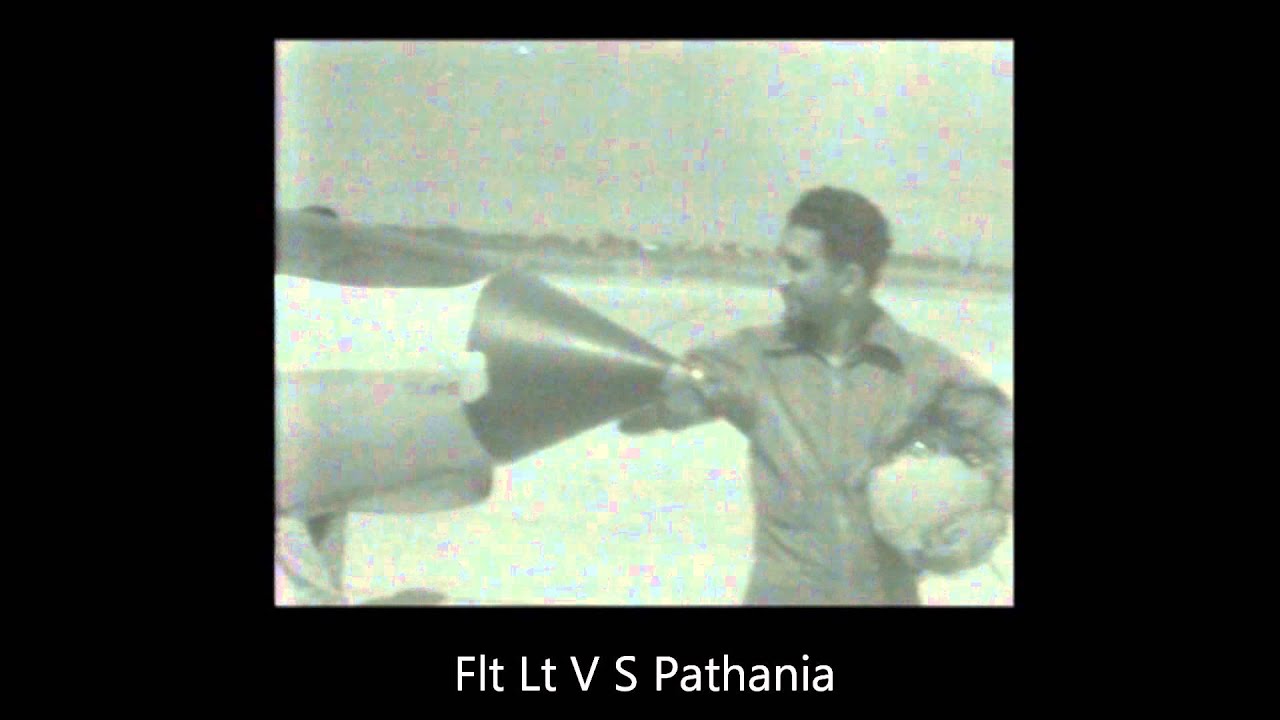
His mastery of the Gnat aircraft earned official recognition in early 1971 with the Vayu Sena Medal (VM) award. The citation spoke volumes about both his technical prowess and leadership qualities:
“Virendra Singh Pathania has been flying the Gnat aircraft since January 1964. He has carried out 692 hours of flying on this type and is one of the most experienced pilots on the Gnat. His profound knowledge of the aircraft has benefited many other pilots, whom he has trained with patience and understanding. His personal qualities in the air and on the ground have been a shining example for his juniors to emulate.”
As tensions with Pakistan escalated in June 1971, the No. 18 Squadron received orders to relocate a detachment to Srinagar to bolster the air defence of the Kashmir Valley. The transition proved tragic when an accident claimed the Squadron’s Commanding Officer. As senior-most flight commander, Pathania stepped in as temporary commander until August 1971, when a new CO was appointed. Given Srinagar’s strategic significance, a small but elite force of five aircraft and eight fully operational pilots, including Pathania, formed a permanent detachment. This compact team would soon face the full might of the Pakistan Air Force.
The air war over Srinagar intensified from December 3rd as the PAF launched repeated raids against Srinagar and Awantipur airfields, attempting to neutralise IAF operations in the northern sector. No. 18 Squadron responded by maintaining continuous Combat Air Patrols while keeping aircraft ready for immediate scramble.

December 6th brought one of the war’s most intense engagements. At 1700 hours, Pathania and Flight Lieutenant B.N. Bopaya were concluding their Combat Air Patrol in deteriorating visibility when CAP control urgently ordered them to accelerate to 400 knots—radar had detected six incoming enemy aircraft. Within thirty minutes, Awantipur shook under enemy bombs, followed by reports of four Sabres approaching from the east at high altitude.
As Bopaya engaged the enemy first, only to be forced away by intense anti-aircraft fire, the PAF Sabres executed a coordinated strike. Six bombs cratered the runway while a fourth Sabre strafed the blast pens, ORP, and personnel trenches.
Pathania, despite facing the heavy ground fire, manoeuvred behind the formation’s No. 2 Sabre. Only his port gun responded when he opened fire, but the hits were compelling enough to force the Sabre into defensive manoeuvres, jettisoning its drop tanks. Despite his partially disabled guns, Pathania maintained the pursuit, scoring additional hits until his second gun also failed. With fuel running critically low, he had to abandon the chase of the damaged but escaping Sabre.
His terse logbook entry captures the intensity of the engagement:
“Air Combat with Sabres (F-86s). Fired at one. Only left gun fired. Hit the Sabre and knocked off his drop tanks. Port gun, too, stopped. Stayed with the Sabre for 9 minutes. It finally staggered across the CFL, smoking away heavily. Landed on a damaged RW in the dark. It went through boulders, but luckily, the Gnat was not damaged. F-86 drop tanks later found by the Army with bullet holes.”
While claimed as a kill, it was never officially confirmed or corroborated by Pakistani records.
However, the events of December 14th left an indelible mark on both Pathania and the IAF. During a Pakistani attack by six F-86 Sabres on Srinagar airfield, Flying Officer Nirmal Jit Singh Sekhon engaged the raiders single-handedly. Despite the overwhelming odds, Sekhon damaged two enemy aircraft before his Gnat was fatally hit. Pathania, monitoring the battle over the radio, ordered Sekhon to climb and eject, but the young pilot’s aircraft was too low for a safe ejection.
The recovery of Sekhon’s body by Pathania and Bopaya marked a sombre moment in the war. Sekhon’s extraordinary courage would earn him the Param Vir Chakra, India’s highest military decoration—the only IAF officer to receive this honour. However, the loss profoundly affected Pathania, who believed the tragedy might have been prevented if the squadron had scrambled more aircraft against the raiders.
His vocal criticism of the decision to launch only two aircraft against six Sabres led to a Court of Inquiry for insubordination. The same officer who had been lauded as an exemplar for junior pilots months earlier found his career progression stalled. Despite this professional setback, Pathania’s integrity remained unshaken. When urged to petition for deserved recognition, his response embodied the warrior-philosopher’s spirit: “I did not fight the war for medals; I fought for my country. And I would do it all over again, the same way.”
Fading into the Sunset
The ace who had once danced with Sabres in contested skies found a different rhythm in his post-combat years, serving the Indian Air Force with the same quiet dedication that had marked his combat career. February 1972 saw Virendra Singh Pathania reunite with his beloved Gnats as Flight Commander of No. 22 Squadron, a position he held until early 1974 before his expertise carried him to Air Headquarters in Delhi’s Directorate of Plans.
Between 1976 and 1979, fate brought him full circle as he returned to Srinagar—the very skies he had once defended so vigorously. His promotion to Group Captain led to his appointment as Chief Operations Officer at Pathankot from 1979 to 1983. The Eastern Air Command then benefited from his extensive experience when he served as Command Air Defence Officer until 1987.

His final formal posting returned him to Delhi’s Air Headquarters, to the Directorate of Intelligence. Though October 1989 marked his official retirement, the IAF knew better than to let such experience slip away entirely, re-employing him in the same directorate until January 1995.
Behind the decorated officer lay a man of remarkable depth and gentle disposition. His passion for Hindi music offered a melodious counterpoint to the thunder of jet engines that had dominated his professional life. An accomplished marksman and photography enthusiast, he brought the same careful attention to detail to his hobbies that had once made him lethal in aerial combat.
Those who knew him spoke of his kindness and readiness to help others, which seemed at odds with his fearsome reputation as a combat pilot. Yet perhaps this very duality—the warrior and the gentleman—made him such an exceptional officer and human being. His quiet, introspective nature belied that he was among the few IAF officers to have engaged in direct aerial combat in the 1965 and 1971 wars, emerging victorious from both conflicts.
But warriors carry burdens invisible to the eye. The weight of combat, lost comrades, and the perpetual vigilance demanded of a fighter pilot left scars that time couldn’t fade. On February 20, 1995, Group Captain V.S. Pathania’s story came to an abrupt end with a massive heart attack. He left behind his wife, three children, and a legacy far beyond combat victories. In an era before the internet reached Indian shores, his stories faded with him.
In many ways, Pathania embodied the ideal of military service—a warrior who fought not for personal glory but for the love of his nation. History will remember him as the first IAF officer to achieve a confirmed air-to-air kill and a defender of Srinagar’s skies. But perhaps his most significant legacy lies in how he carried himself after those historic achievements: humility, dignity, and an unwavering commitment to service.

His story powerfully reminds us that behind every military achievement lies a human story, complete with triumphs and struggles. This account owes its existence to his daughter Preeti Pathania, who patiently answered countless questions to help piece together her father’s legacy, Wing Commander KS Jaijee, who facilitated this family connection, and the numerous veterans who served alongside Pat Pathania, sharing their treasured memories and anecdotes.
———-
PS: Many veterans also recollect Parshottam Singh Pathania (5112) from the 68th Course in Pathankot in the 1990s. That officer is different from Virendra Singh “Pat” Pathania (5198) from the 69th Course described above. Both were serving as re-employed Group Captains in the early 1990s.
PS2: Below are some quotes from officers who served with Pat Pathania and shared these memories on reading the post:
He used to wear a colourful Gnat upper-arm patch on his overalls, in zari & silk thread, with the inscription ”The Last Little Fighter”!!! Being a rather small built man, that patch eloquently described both him & his famous mount rather befittingly!!!! One had seldom come across a more endearing, self-effacing, humble, soft spoken & reticent individual & fighter jock than Pat, given his high professional calibre, proven live combat performance & shining reputation from the 1965 Indo-Pak air war!!
I knew Groupy Pathania quite well as he was the COO at Srinagar when I was posted at 2 Sqn, flying Gnats. A soft spoken officer and a perfect gentleman.
He was our flight commander in 22 Sqn. Then we were together in AIR HQ. He was re employed. A thorough gentleman and quiet person.
I knew the officer because I was operating out of Pathankot in 1965. He was indeed a quiet, soft spoken officer; qualities I endorse wholeheartedly.
⭐ This post previously received 5.0/5 from 171 readers in our legacy system.


Leave a Reply