

For years, I chased a ghost through the archives of the Indian Air Force. No. 1 Equipment Depot. I’d stumble across mentions of No. 2, No. 3, and No. 4 in faded records and unit histories. And yet, no matter where I looked, there was never a trace of No. 1. No location. No history. No formation order. Nothing.
At first, I chalked it up to the chaos of history. Maybe it had been partitioned to Pakistan in 1947. Perhaps it was disbanded early, or the records were simply lost to time. But as I dug deeper, every theory crumbled. The absence wasn’t a mistake; it was intentional. No. 1 Equipment Depot never existed.
That realisation did not answer a single question. It detonated many more. If the numbering skipped No. 1 on purpose, then the IAF’s post-Independence maintenance and logistics system wasn’t the haphazard patchwork it seems in retrospect. It was a deliberate design, a blueprint crafted from the ruins of empire and war.
Which meant that somewhere beneath decades of renamings, closures, mergers, and reorganisations lay a coherent blueprint that had simply been forgotten. This piece is an attempt to reconstruct that logic, and in doing so, to recover a system that once made complete sense, even if it no longer looks that way today.
The Inheritance: What the RAF Left Behind
To understand the IAF’s blueprint, we must first grasp what it inherited. Before World War II, the RAF in India operated on a shoestring: just four Maintenance Units (MUs), numbered 1 through 4, stationed at Karachi, Allahabad, Ambala, and Kanchrapara. These were modest facilities supporting a peacetime garrison on the fringes of Britain’s aerial empire.

Maintenance Units, or MUs, were a generic organisational label rather than a precise descriptor. They were versatile hubs handling everything from aircraft repairs and engine overhauls to equipment storage, ammunition depots, and even motor transport servicing. But in 1942, as India became a linchpin in the Allied war effort, supplying the Burma campaign and operations across the Middle East, China, and beyond, the system transformed.
Between 1942 and 1945, the RAF expanded this support structure at remarkable speed. By the end of the war, roughly forty Maintenance Units were operating in the Indian subcontinent. To distinguish them from earlier peacetime units, these formations were numbered in the 300s. They were spread across seven broad functional roles, shaped by wartime necessity rather than any long-term architectural plan.
As the war expanded, the network expanded with it. Units were created, moved, repurposed, and enlarged wherever geography, rail access, ports, or operational demand required. When the war ended, the process reversed. Aircraft types vanished, surplus accumulated, and many units quietly contracted or disappeared altogether.
A few locations, however, assumed disproportionate importance. Karachi and Drigh Road emerged as enormous hubs for repair, storage, and assembly. Lahore supported both repair and staging functions. Kanpur and Allahabad handled a mix of repair, storage, and disposal activities further east. Bombay and Madras acted as maritime gateways for aircraft and equipment arriving by sea. Explosives and ammunition were deliberately dispersed, with depots at Pulgaon, Kasu Begu, Jabalpur, Gummidipoondi, and across Bengal and Assam.
By 1945, this had become a formidable machine. It sustained a global air war. However, two key characteristics of this system would profoundly influence the post-war era. First, it was never intended as a permanent national framework; it was a temporary wartime construct, aligned with RAF commands. Second, it was already in decline as the war ended. With victory in sight, units began contracting: facilities were mothballed, and personnel were demobilised. The system India and Pakistan would inherit was not at its zenith but in a state of managed retreat.
To illustrate the breadth of this wartime expansion, here’s a categorised breakdown of the MUs by their primary roles:

The Shadow of Partition: What Remained in 1947
By the time Independence arrived in August 1947, the RAF maintenance system in the subcontinent was already well past its wartime peak. Of the roughly forty Maintenance Units that had operated across India during the war, fewer than half still existed in any meaningful form. What India and Pakistan were dividing was not a fully functioning wartime machine, but the residue of one already being wound down.
Even within that residue, the inheritance was uneven. India emerged with a larger number of surviving units overall, roughly eighteen by most reasonable counts. These were spread across ammunition and explosives depots, equipment depots, aircraft storage and disposal sites, and a wide but thinly distributed network of motor transport units across the peninsula. Pakistan inherited fewer units in absolute terms, perhaps seven, but they included some of the most mature and capable elements of the system.
The sharpest imbalance lay in aircraft repair and overhaul. The deepest repair capability in the subcontinent sat at Drigh Road near Karachi and at Lahore, both of which fell on the Pakistani side of the new border. India, by contrast, entered independence with little surviving wartime repair capacity of comparable depth. That disparity mattered far more than raw unit counts.
Other roles told a different story. Equipment depots were more evenly distributed numerically, with India retaining facilities at Allahabad, Bombay, Avadi, and Cochin. In contrast, Pakistan retained depots linked to Lahore and Karachi, which were closer to major repair hubs. Aircraft storage units predominantly stayed in India, but their value was questionable; many dealt with surplus wartime aircraft awaiting disposal rather than active fleet support. Ammunition and explosives depots overwhelmingly favoured India, a legacy of the RAF’s strategic dispersal into central and southern regions to avoid frontline risks. Motor transport units followed suit, scattered broadly across Indian soil for logistical reach, whereas Pakistan’s were fewer and more concentrated near its airfields.
This was the landscape the Indian Air Force confronted in its first weeks. There was breadth, but little depth: storage, explosives, and transport were plentiful; deep repair was not. Pakistan inherited fewer pieces, but some of the most critical ones. The choices the Indian Air Force made in late 1947 only begin to make sense once this starting point is understood correctly. The following table captures this divide:
| Category | India | Pakistan |
| Total units still relevant | ~18 | ~7 |
| Aircraft repair capability | Very limited | Strong |
| Equipment storage | Strong | Moderate |
| Aircraft storage | High (low utility) | Low |
| Ammunition & explosives | Strong | Minimal |
| Motor transport | Strong (dispersed) | Limited (centralised) |
The Indian Air Force Plan: From Fragments to a Coherent Blueprint
Seen against the reality of what survived in August 1947, the Indian Air Force’s early maintenance and logistics plan appears far more deliberate than it is usually credited for. It was inheriting fragments: strength in ammunition storage, motor transport, and aircraft holding, but a clear deficit in deep repair and overhaul. Simply renaming RAF Maintenance Units and carrying on would have locked those distortions in place.
Instead, by late 1947, the Indian Air Force settled on a remarkably simple and rational schema. It distilled its inheritance into ten core maintenance and logistics units, each with a clearly defined role, and numbered them 1 through 11. The numbering was neither chronological nor implied to have missing predecessors. It reflected design intent.
It is worth noting that some renaming had already begun earlier in 1947. The RAF had redesignated certain Maintenance Units as it prepared its own withdrawal. Bombay’s No. 305 MU had become No. 2 Equipment Depot, and No. 307 MU at Lahore had been redesignated No. 1 Aircraft Repair Depot in April 1947. This, however, was not a partition plan. It was an RAF exit arrangement. The Indian Air Force’s scheme went further, and in a different direction.
The most critical decision was the anchoring of the system at Kanpur. Although Kanpur had not been the RAF’s deepest repair hub during the war, it had accumulated enormous wartime stocks and infrastructure. Liberators, Dakotas, Hurricanes, Tempests, Spitfires, Harvards, Prentices, and their engines were already concentrated there, largely through the late-war activities of No. 322 Maintenance Unit. From this base, the Indian Air Force established No. 1 Aircraft Repair Depot at Chakeri, paired deliberately with No. 10 Aircraft Storage Unit, also at Chakeri. Together, these two units recreated in Indian hands a capability that Partition had otherwise left dangerously thin.

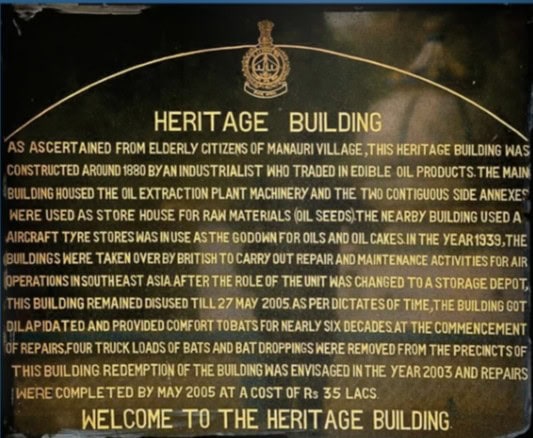
General equipment storage was handled differently. Rather than centralising it, the IAF spread this function geographically, reusing large wartime Universal Equipment Depots. No. 2 Equipment Depot was located at Bombay, No. 3 at Avadi near Madras, and No. 4 at Manauri near Allahabad. Each of these sites had been significant RAF equipment depots during the war, and each was repurposed with minimal disruption. The absence of a No. 1 Equipment Depot was not an oversight. The IAF never intended to create one. In its scheme, the number “1” was reserved for aircraft repair, not general storage.
Explosives and ammunition were treated as a specialised and sensitive domain. Here, the wartime RAF dispersal across central and southern India worked decisively in India’s favour. The IAF created four Explosive Maintenance Units, numbered 5 through 8, at Jabalpur, Gummidipoondi, Pulgaon, and Kasu Begu. These locations directly inherited RAF ammunition depots and together formed a resilient, geographically distributed explosives network.
Motor transport, essential for a force operating across a vast subcontinent, was centralised at Poona as No. 9 Motor Transport Storage Unit and at Palam as No. 11 Motor Transport Storage Unit, again drawing directly on existing RAF motor transport infrastructure.
Taken together, this was a consciously engineered logistics backbone. With just ten units, the Indian Air Force covered aircraft repair, aircraft storage, general equipment, explosives, and motor transport, with minimal overlap and maximum reuse of inherited infrastructure. More importantly, it corrected the most dangerous imbalance exposed by Partition by prioritising aircraft repair as the system’s first principle.

The Legacy of a Forgotten Blueprint
The quest for the elusive No. 1 Equipment Depot began as a minor enigma but unveiled a profound insight: the unit’s absence was by design, reserving the top spot for what mattered most, aircraft repair. This blueprint, with its ten foundational units, represented the IAF’s early ingenuity, creating order from colonial chaos and Partition’s inequities.
None of these original ten units survives today in its original form, but they do survive. Over the next two decades, the system expanded rapidly. Ten units became twenty-five. New categories appeared. Old distinctions blurred. That evolution, and the reasons behind it, belong to the next part of this story.
For Part 2, we’ll also dive deeper into one iconic element: the celebrated No. 1 Base Repair Depot at Kanpur, often attributed to the legendary Group Captain Harjinder Singh. But as my research suggests, the standard narrative of its origins may need reevaluation. What if its roots are more intertwined with this blueprint than we think? Stay tuned for that unravelling.


Leave a Reply