

With deep sorrow and profound respect, we mark the passing of Air Marshal Ravinder Nath Bharadwaj, PVSM, MVC, VM, at 89 yesterday. Affectionately known as “Mummy,” a nickname that originated from his sweet demeanour and was bestowed upon him by the CO of the Pilot Attack Instructor school, Nobby Clarke, Air Marshal Bharadwaj’s legacy is one of courage, dedication, and exemplary service to the nation.

He was commissioned into the Indian Air Force in 1955 from the 66th Pilot Course in the fighter stream, embarking on a career to become a celebrated combat pilot and a revered military leader. His journey as a pilot was marked early on by his qualification as a Pilot Attack Instructor in 1961, a role equivalent to the modern-day “Top Gun,” highlighting his exceptional flying skills and tactical understanding.
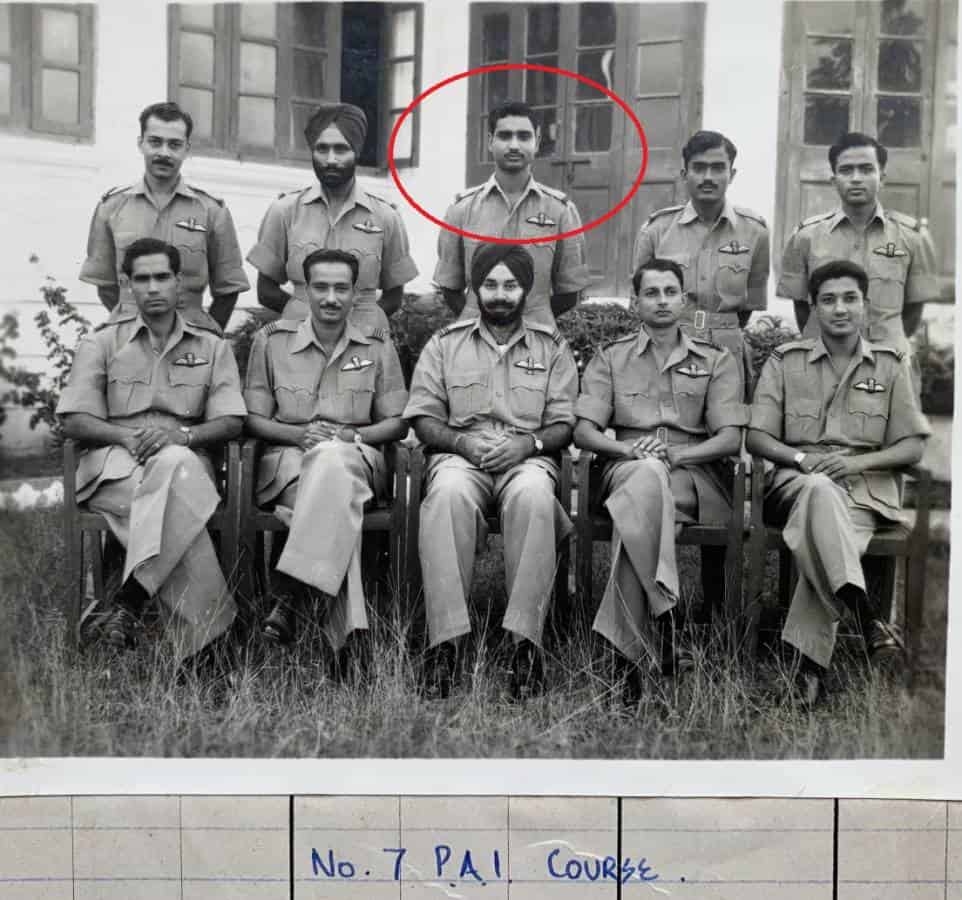
Air Marshal Bharadwaj’s contributions to military training were significant and far-reaching. He served as an instructor in Iraq and was instrumental in training Hunter pilots at the Operational Training Unit before the onset of the 1971 War, earning him the Vayu Sena Medal for his training and operational preparedness excellence.
The 1971 War saw Squadron Leader Ravinder Nath Bharadwaj, affectionately known as “Mummy,” play a crucial role in the Indian Air Force’s operations against Pakistan, serving with the 20 Squadron operating the Hunters. His leadership and bravery during this conflict were instrumental in several critical missions that significantly impacted the war’s outcome.

As dawn broke on December 5th, 1971, Squadron Leader Bharadwaj and Flight Lieutenant Gahlaut embarked on a daring raid against the Chaklala airfield in Pakistan. This mission followed a successful attack the previous day led by Lieutenant Arun Prakash and his wingmen, who had already inflicted considerable damage. Bharadwaj and Gahlaut continued this momentum, contributing to the mission’s success by destroying a C-130 transport aircraft and Gahlaut taking out a Twin Otter. He also destroyed Chuck Yeager’s Beechcraft Queen Air in that raid.
On December 7th, Bharadwaj led a four-aircraft mission against the strategically vital Mangla Hydel Dam. The squadron flew Hunters equipped with rocket pods. The mission succeeded despite encountering anti-aircraft defences and experiencing several equipment malfunctions, including cannon stoppages and rocket pod failures. The raid effectively damaged the Hydel Station at the dam’s foot.
Continuing their operational momentum, Bharadwaj led another critical mission on December 8th, targeting the Murid airbase. The successful destruction of a transport aircraft by Bharadwaj and the attack on two MiG-19 fighters by his wingmen, Karumbaya and Deoskar, was a glaring success.

On December 10th, Bharadwaj and “Lofty” Karambaya were detailed for a sortie to support the army in the Chamb area. Their aircraft, equipped with full HE ammunition, 230-gallon inboard drop tanks, and SNEB Rocket Pods, were primed for a comprehensive assault. As they approached the designated target area, a Pakistani Sabre jet suddenly sliced through them, unleashing a barrage of fire at Karambaya. Karambaya executed a series of tight turns and climbs, demonstrating exceptional aerial agility, evading the Sabre’s aggressive positioning before finally disengaging. This manoeuvre provided Bharadwaj with a crucial opportunity. Rapidly closing the distance to the enemy at an impressive speed and proximity of approximately 400 yards, opened fire, leading to the Sabre’s immediate disintegration. Bharadwaj, maintaining his momentum, continued his assault on Pakistani tanks and additional targets on the ground.

His leadership, courage, and flying skills exemplified the highest traditions of the Indian Air Force, earning him the Mahavir Chakra and a revered place in India’s military history, becoming one of only two Squadron Leaders to be honoured in the war with the MVC.
His post-war career was no less distinguished. Commanding the 26 Squadron and flying the Su-7 in 1974, he transitioned to senior command roles with aplomb. His leadership at the Air Force Station Bareilly, the Advance Headquarters at Chandigarh, and later as the AOC-in-C of Southern Air Command underscored his versatile and practical command style. Air Marshal Bharadwaj’s expertise also led him to significant staff appointments, including Director and later Assistant Chief of Plans and Inspection, Deputy Commandant of the National Defence Academy, and SASO of Training Command, before his retirement in July 1993.
In 1995, he suffered a severe stroke, resulting in him almost isolating himself from social engagements. Over the years, though, he recovered somewhat; he remained less so in public glare and preferred to remain with a close set of friends and family. His life and service have inspired many, leaving an indelible mark on the hearts and minds of those who served with him and those who will continue to look up to his legacy. Our thoughts and prayers are with his family during this difficult time.
Air Marshal Bharadwaj’s passing is not just the loss of a decorated hero but brings us closer to the end of a glorious era for the Indian Air Force. Of the 21 Mahavir Chakras awarded to 19 Indian Air Force officers thus far, only Air Vice Marshal CV Parker and Air Chief Marshal SK Kaul survive today.

⭐ This post previously received 5.0/5 from 23 readers in our legacy system.


Leave a Reply