
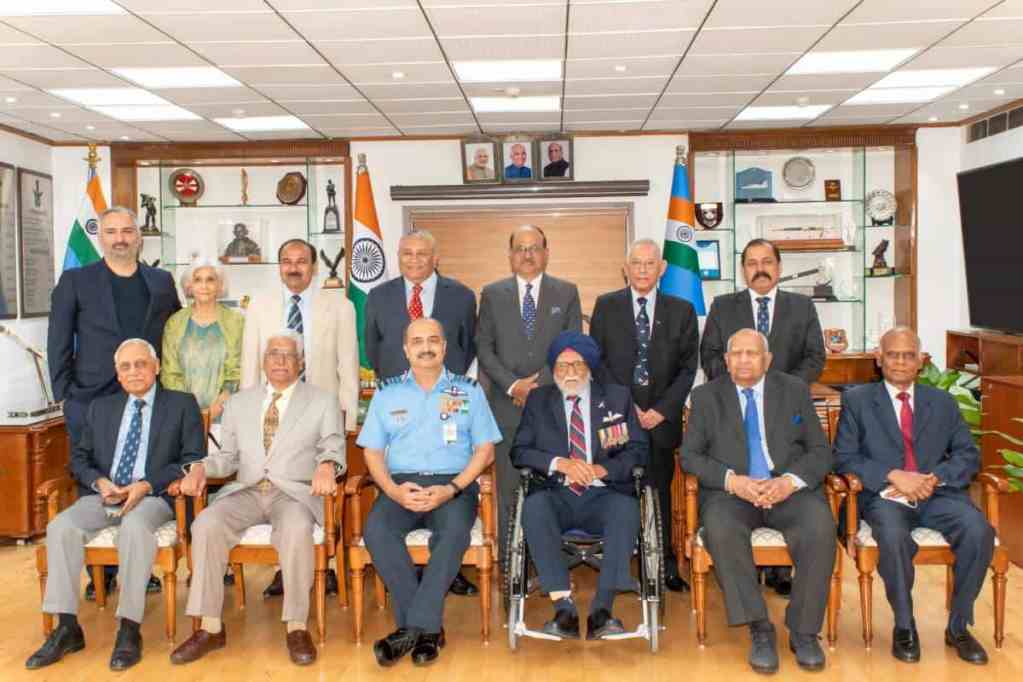
Dalip Singh Majithia, the oldest surviving fighter pilot of the Indian Air Force, celebrates his 102nd birthday today. With a distinguished seven-year career, Majithia logged over 1100 flight hours across 13 different aircraft types and participated in World War II combat missions over Burma, marking an era of rapid growth and intense action for the IAF.
Born on July 27, 1920, in Simla, at Skiplin Villa—a property owned by his mother’s royal family from Patiala—Dalip was the fourth of five children. His father, Kirpal Singh Majithia, and his grandfather, Sardar Sundar Singh Majithia, who was Punjab’s first Revenue Minister, were prominent figures in his early life.

Dalip Singh Majithia’s formative education took place at home under the guidance of a tutor in Sardarnagar, the ancestral estate prominently featured in Lepel Henry Griffin’s “The Punjab Chiefs.” Originally called Dumri, the estate was awarded to Dalip’s great-grandfather following the 1857 mutiny and was subsequently renamed Sardarnagar.

At the age of ten, Dalip was enrolled at Khalsa College in Amritsar, furthering his education in Lahore where he completed his Bachelor of Arts. Poised to pursue higher education at Cambridge University in the UK, Dalip’s plans took a dramatic turn when his passion for horses and riding drew him toward a military career in the Cavalry instead.

As World War II escalated, Dalip Singh Majithia felt the pull of duty influenced by his uncle, Surjit Singh, who had joined the Indian Air Force (IAF) in November 1939. Encouraged by his family, Dalip applied to the newly established IAF Volunteer Reserve in early 1940.

Dalip underwent a rigorous selection process, which included interviews in Simla and Ambala, notably by then Squadron Leader Subroto Mukerjee, a future Air Chief Marshal of the IAF. Successfully selected, Dalip was directed to the Karachi Flying Club to gain basic flying skills and undergo aptitude testing. There, under the instruction of Mr. N.R. Gogte, he trained on the Gypsy Moth aircraft, laying the groundwork for his future in aviation.

On August 1, 1940, Dalip Singh Majithia embarked on a journey in his aviation career by joining the 4th Pilot Course at the Initial Training School (ITS) in Walton, Lahore. This was the first course held at ITS, and Dalip was one of 72 cadets, a group that would eventually become the leading figures of the Indian Air Force over the next three decades.

Dalip took to the skies for his first sortie on August 5 and achieved his first solo flight just a few weeks later on August 22. By the end of November 1940, after accumulating 58 flight hours on the Tiger Moth, he was awarded the best pilot trophy—an early recognition of his flying prowess. Dalip had not yet earned his wings, prompting his next assignment to the No. 1 Flying Training School in Ambala to continue his advanced training.

During that era, officers began their tenure as “Acting Pilot Officers” upon their arrival at Walton. Dalip Singh Majithia and his uncle, Surjit Singh, who was approximately eight years his senior, were both commissioned on the same terms. This unique circumstance marked them as the IAF’s first uncle-nephew duo, setting a precedent for others that followed.

Dalip spent six months at Ambala, where he intensively trained and logged approximately 150 hours of flight time. His training regimen covered a wide array of skills, including map reading, night approaches, aerobatics, formation flying, forced landings, and instrument flying. He flew on several aircraft types during this period, including the Wapiti, Audax, and Hawker Hart. This comprehensive training culminated in Dalip earning his coveted wings on May 24, 1941, a significant milestone in his aviation career.

In response to the growing needs of World War II, six Coastal Defence Flights (CDF) were established in 1940, staffed primarily by pilots from the Indian Air Force Volunteer Reserve (IAFVR). In June 1941, Dalip Singh Majithia was assigned to the No. 1 CDF based at St. Thomas Mount in Madras, where he spent the next 15 months. During this period, he piloted a variety of aircraft including the Wapiti, Hart, Audax, and Atlanta, undertaking missions critical to coastal security such as patrols, convoy escorts, and naval reconnaissance.

Service with the CDF offered a range of unique and challenging experiences. Dalip participated in complex operations such as ferrying Wapitis from Madras to Karachi, a journey that spanned three days and involved over 15 hours of flight time. Additionally, he encountered unconventional aspects of military aviation, such as carrying homing pigeons in the cockpit of the Atlanta for communication purposes. His duties also involved searching for and bombing submarines and conducting single-aircraft patrols over the sea—an essential but perilous task that underscored the strategic importance of these flights during the war.

By November 1942, the Coastal Defence Flights were disbanded as the aircrews transitioned to regular squadrons—specifically the newly formed Indian Air Force Squadrons 4, 6, 7, and 8, all established that year. Dalip Singh Majithia was then posted to 151 Operational Training Unit (OTU) at Risalpur to undergo conversion training on the Harvard and Hurricane aircraft, preparing him for imminent deployment to the war front.

In March 1943, Dalip joined No. 6 Squadron as a flying officer under the command of the legendary Mehar Singh. The squadron, newly assembled, was frequently on the move, ultimately reaching Cox’s Bazar in November 1943. Here, they undertook reconnaissance missions that were crucial for the success of the 14th Army, earning them the esteemed nickname “Eyes of the 14th Army.” Dalip’s time with the squadron was impactful but brief, as he was posted out in December 1943.

In January 1944, Dalip Singh Majithia received a new assignment as Flight Commander of No. 3 Squadron, where he piloted the upgraded Hurricane IIC. The squadron was relocated across the country to Kohat, under the leadership of Prithpal “Polly” Singh, one of the last officers from the prestigious Cranwell academy. During his tenure at 3 Squadron, Dalip flew alongside notable figures such as Asghar Khan, who would later become the Chief of the Pakistan Air Force, and Sam Manekshaw, then a Major and future Field Marshal of India.

While stationed at Kohat, 3 Squadron was actively engaged in operations against the Faqir of Ipi, a local insurgent leader intensifying his activities. Dalip’s logbooks detail missions involving reconnaissance, leaflet dropping, and bombing, with deployments extending to Miranshah. These missions were critical in maintaining control over the turbulent region. Dalip’s service with 3 Squadron concluded in December 1944, just days before his commanding officer, Prithpal Singh, tragically died in a crash.

In January 1945, Dalip Singh Majithia returned to the Eastern front with aspirations of becoming a squadron commander. Instead, he was appointed Flight Commander of No. 4 Squadron, equipped with Hurricane IICs and Spitfire VIIs, based in Arakan under the leadership of an RAF Squadron Leader, Sharp. Here, Dalip engaged extensively in bombing and strafing missions.

However, his active duty was abruptly interrupted at the end of February 1945 when he fell seriously ill and required urgent medical attention. Flight Lieutenant Asghar Khan, his former squadron mate, piloted the Harvard aircraft that transported Dalip to a hospital in Calcutta. His journey to recovery was extensive; from Calcutta, he was moved via Poona, Begumpet, Santacruz, Karachi, then internationally through Cairo and Sicily to London aboard an RAF Sunderland flying boat. After months of treatment and convalescence, Dalip made a full recovery from his mysterious illness and returned to Delhi in August 1945.

After a period of convalescence, Dalip Singh Majithia briefly rejoined 4 Squadron in October 1945, where he successfully piloted his first solo flight in nine months. Although his health was improving, his medical category had not yet been restored to its optimal status. Recognizing his skills and leadership, Dalip was soon promoted and reassigned to Air Headquarters as a Squadron Leader in charge of operations.
By December of that year, Dalip was assigned a new mission that took him on an international route, flying to Perth via Colombo and Coco Island aboard a C-54 Sky Master. His journey continued to Melbourne, where he served as the Indian Air Force’s Liaison to the Joint Chief of Staff in Australia. In this role, he was responsible for overseeing the orderly disengagement of Commonwealth Occupation forces, which included not only his own No. 4 Squadron but also units from the RAF, RNZAF, and RAAF.

Following the successful completion of his duties in Australia, Dalip Singh Majithia returned home and formally retired from the Indian Air Force on March 18, 1947, closing a chapter of distinguished military service.

While stationed in Australia, Dalip Singh Majithia met Joan Sanders, a member of the Women’s Royal Australian Naval Service, who would become his future wife. Encouraged by his family to oversee their substantial business interests and uncertain about the prospects of the Indian Air Force in the post-WWII environment, Dalip made the decision to leave the IAF. In 1948, he married Joan and they settled in Sardarnagar.

Dalip held a deep respect for Mehar Singh, whom he considered not just a commander but a mentor, and his admiration for him persists to this day. Of all the aircraft he piloted, the Hurricane remained his favorite, epitomizing the spirit of his flying career. Although he retired from military service, Dalip’s passion for flying never diminished. He continued to fly L-5s purchased by his family and later acquired two Beechcraft Bonanzas, actively piloting until 1979. His enduring love for aviation is a testament to his remarkable journey as a pilot.

The Majithia family’s passion for aviation extended beyond Dalip, influencing even diplomatic circles. Surjit Singh Majithia, Dalip’s uncle and the first Indian Ambassador to Nepal, played a pivotal role in advancing aviation between the two countries. Responding to Nepal’s request to establish an air route, Surjit entrusted Dalip with this significant task. On April 23, 1949, Dalip made history by successfully landing on an unprepared airstrip in Kathmandu, a feat that marked the beginning of what would become the city’s international airport

Dalip’s pioneering flight originated from Muzaffarpur, navigating along the Bhagmati River to a makeshift runway measuring just 150 by 1200 yards. In a display of ingenuity and coordination, Surjit placed his car at the southern end of the strip, marking it with a “T” next to which he arranged balls labeled 1-2-3 to indicate different wind speed ranges. This innovative system allowed Dalip to accurately gauge his approach, culminating over six months of meticulous planning. This landmark flight not only cemented the Majithias’ legacy in aviation but also significantly contributed to the development of air travel in Nepal.

Following his notable achievements in aviation, Dalip Singh Majithia transitioned into business, acquiring an agency in Muzaffarpur that dealt in General Motors vehicles and Ferguson tractors. This venture enabled him to forge connections with the Nepalese aristocracy in Kathmandu, to whom he sold cars. Later, Dalip moved back to Saraya where he established a steel furnace and rolling mill, further diversifying his business interests and settling his life in Gorakhpur.

Interestingly, part of the Air Force Station Gorakhpur is situated on land that was once owned by the Majithia family, highlighting the deep ties between the family and the region. Dalip’s wife, Joan Sanders Majithia, passed away in 2021. Despite personal losses, Dalip has remained active, particularly in sports like golf, and he divides his time among his residences in Delhi, Rudrapur, and Gorakhpur. Even in his later years, he continues to enjoy life’s finer pleasures, including “two measured small drinks of Teacher’s 50” each day.

In Dalip Singh Majithia’s logbook, recorded during his illness in 1945, there is a poignant entry that seems to echo the sentiments expressed by Amitabh Bachchan’s character many years later in the film “The Great Gambler.” The entry reads:
“Do lafzon mein meri kahaani hai, ek lafze mohabat hai, doosra lafze jawaani hai”.
This succinct reflection encapsulates the essence of his adventurous spirit and romantic heart, resonating through time in both personal recounts and cinematic expressions.

Originally published on Twitter


Leave a Reply