
In a quiet corner of an Indian Air Force veteran’s closet sits a modest yet historic trophy. Topped with a fin-stabilised rocket and marked simply with the letters “ATW,” it reads: “Noronha Trophy.” At first glance, it might appear to be just another piece of forgotten memorabilia. But for those who know its story, this was once the most coveted recognition among the IAF’s sharpest air-to-ground warriors—awarded to the best pilot from each Pilot Attack Instructor (PAI) course.
Instituted at the Armament Training Wing (ATW) in Jamnagar—the cradle of Indian air-to-ground warfare training—the Noronha Trophy recognised the top graduate from the PAI Course, which began in 1958, the IAF’s version of a “Top Gun” programme. But the roots of the trophy, and the story behind its name, go far deeper.
Laying the Foundation: Air Combat Training in Colonial India
The Indian Air Force, born under colonial oversight, initially relied on the Royal Air Force for combat tactics and instructional structure. But knowledge transfer was sparse, unstructured, and highly selective through the 1940s.
The RAF established several key institutions in India to address these gaps during World War II. The Armament Training Unit (ATU) was raised in Peshawar in 1942 to train pilots in gunnery and bombing. The Low Attack Instructors School in Ranchi specialised in ground-attack tactics. In 1943, the RAF set up one of only two Air Fighting Training Units (AFTUs) worldwide at Amarda Road, commanded by the legendary Frank Carey, a veteran of both the Battle of Britain and the Burma campaign.
At AFTU, Indian pilots underwent rigorous instruction in gunnery, bombing, navigation, formation flying, and fighter affiliation. Among the first to attend in 1943 were M.K. Janjua, Shiv Dev Singh, and B.S. Dastur. Others, including Ranjan Dutt and K.B. Joshi, were sent to the RAF’s Day Fighter Leaders School at Tangmere, UK, where they completed demanding tactical courses on Spitfires in 1945–46.
By 1946, however, most of these Indian-based institutions had shut down. As Independence loomed, the IAF inherited virtually no domestic infrastructure for institutionalised air combat training.
In the early 1950s, the IAF began rebuilding its lost architecture. A select few pilots were again sent to Australia and the UK to undergo PAI training, but there was growing urgency to bring such training home. Simultaneously, the IAF scouted for a permanent air-to-ground training site. Locations like Maharajpur, Bhopal, Amarda Road, and Cholavaram were considered, but ultimately, Jamnagar was chosen.
The Armament Training Wing (ATW) was formally established in April 1951. The first fully Indian-run Pilot Attack Instructor Course commenced with sustained effort in April 1958. Over the next 12 or so years, 24 such courses were conducted, training nearly 200 pilots, including three who would become Chiefs of Air Staff.
But, who Was Noronha?
The story of the Noronha Trophy begins, as all meaningful trophies do, with a man who defined excellence and sacrifice. Wing Commander Sidney Basil Noronha, MVC, was not merely an officer of the Indian Air Force—he was one of the men who laid the foundations on which the IAF would later build its legacy in air-to-ground warfare and pilot training.
Born in Tiruchirappalli and educated at St. Joseph’s College, Noronha was commissioned into the General Duties (Pilot) branch of the Royal Indian Air Force in November 1941 as part of the 9th Pilot Course. He flew operational sorties during the Arakan and Burma campaigns, earning early recognition for his courage and capability. This was the era of canvas-skinned aircraft, jungle airstrips, and hostile terrain. Flying was dangerous. Noronha survived five aircraft crashes across five different types—a Lysander, Audax, Hurricane, Tiger Moth, and Tempest—between 1943 and 1947.
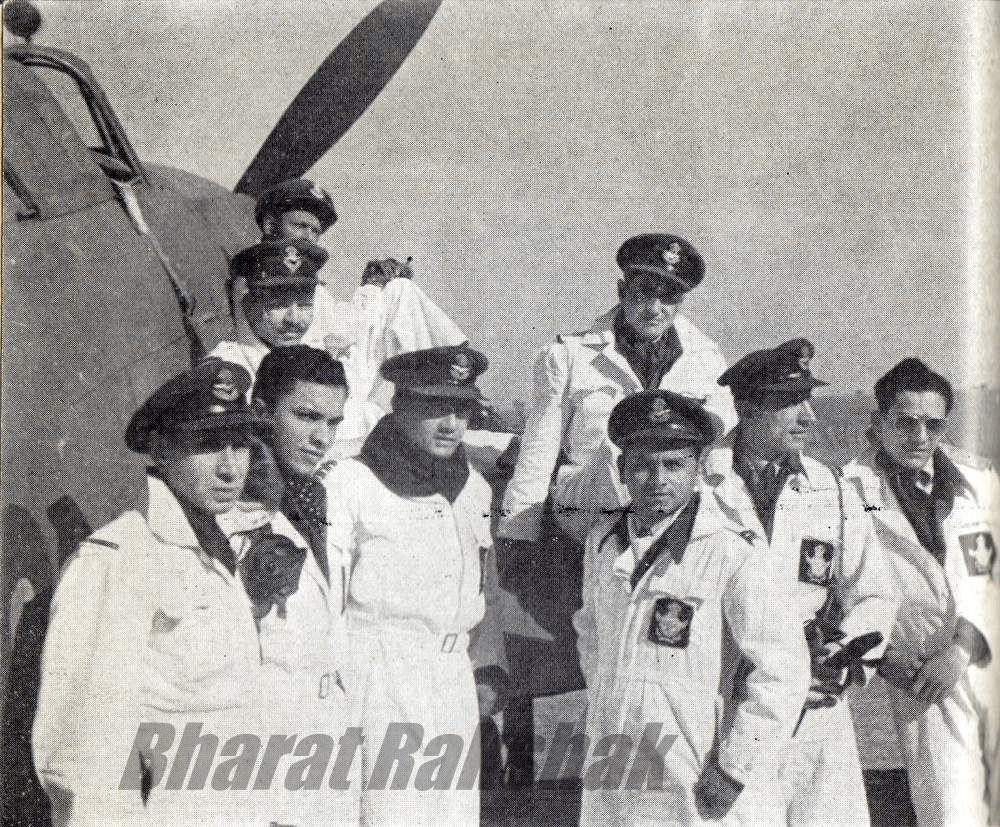
Through the war, he steadily climbed the ranks. By 1945, he had been selected to attend the Pilot Attack Instructor’s Course in the United Kingdom, a rare distinction he completed with credit. He later served with No. 4, 3, and 6 Squadrons and was eventually posted as Flight Commander of No. 2 Squadron at Kohat. He also briefly served with the newly formed IAF Display Flight, adding another dimension to his diverse career.
Yet, Noronha’s true test came not in training halls or jungle skies, but in the crucible of India’s first war as an independent nation. In July 1947, with Partition looming and riots tearing through the subcontinent, Noronha was posted to command No. 7 Squadron after the tragic death of its then CO, Sqn Ldr Mishra, in a jeep accident. Based at Risalpur, the squadron had just begun converting to Hawker Tempest IIs and was earmarked for retention by India.
Under Noronha’s command, the squadron was rapidly moved to Agra, and by the time Pakistani-backed tribal forces invaded Kashmir in October 1947, the unit was combat-ready. It flew its first sorties from Ambala and was instrumental in the decisive Battle of Shalateng, followed by operations over Uri, Kotli, and Rawalkot. In just one month—November 1947—the squadron flew 121 operational sorties, a staggering achievement considering it often had only three serviceable Tempests at a time.
Noronha, as always, led from the front. On 10 December 1947, during a daring strike over Kangrail, his Tempest was hit by ground fire. With damaged controls and a jammed throttle, he nursed the aircraft back toward Jammu, but was ultimately forced to bail out. Severely injured, he was evacuated to Delhi. Noronha was awarded the Maha Vir Chakra for his leadership and bravery, one of only four IAF recipients at the time. He was just 30 years old.

Following recovery, Noronha held significant appointments at Air Headquarters, including as Deputy Director in the Directorate of Personnel Officers, a role equivalent today to an Assistant Chief of Air Staff. In October 1952, he took over as Station Commander of ATW Jamnagar—a post that would define his final legacy.
The Legacy
India had, until then, no institutionalised method of grooming its strike instructors. Several officers had gone to the RAAF and the RAF Fighter Leaders School. Still, there was no structured, domestic course for training pilots in ground-attack and fighter combat doctrine. At ATW, Noronha set out to change that. Over three years, he laid the foundational work for what would become India’s Pilot Attack Instructor (PAI) Course—a precursor to the modern Fighter Combat Leader (FCL) Course of TACDE. He helped establish gunnery and rocketry ranges, developed a training curriculum, and built a core instructional faculty from scratch.

In 1955, he attended the Staff Course at DSSC Wellington, returned to Air Headquarters, and was appointed Staff Officer to the Chief of the Air Staff. But fate had other plans. On 22 August 1957, Wing Commander Noronha died suddenly, at the age of 38. He was buried with full military honours at the New Delhi Cemetery, leaving behind a grieving family—his widow and two young children—and a legacy that would outlive him.

Less than a year later, the first PAI course, his vision made real, graduated from ATW Jamnagar. When Flight Lieutenant Ranvijay Singh was declared the best pilot in July 1958, the Indian Air Force made a symbolic choice. It named the award for the course topper the Noronha Trophy. The trophy was presented at a ceremonial gathering by the Jamsaheb of Nawanagar, whose princely state supported the establishment of the training wing.
For over a decade, the Noronha Trophy became the IAF’s most prestigious air-to-ground honour—awarded for tactical brilliance, instructional potential, and leadership that could tilt the balance in war. With the phasing out of the PAI programme in the 1970s and the rise of TACDE and its FCL Course, the trophy gradually faded from institutional memory.

But its name still carries the weight of all Noronha gave—and all he built.
Today, Wing Commander S.B. Noronha remains one of just nineteen IAF officers to have received the Maha Vir Chakra. He survived five crashes, commanded a squadron in war, built India’s first strike training institution, and died in service of an Air Force still shaping itself. The trophy may be forgotten in display cabinets and storage rooms—but the man, and his vision, live on in every strike sortie flown by a pilot trained to lead from the front.


Leave a Reply