

On a brisk January morning in 1952, a group of young cadets and officers from the Joint Services Wing—later known as the National Defence Academy—arrived in Jodhpur with palpable anticipation. They had come from Dehradun, carrying the weight of history and a shared secret pride. For this was no ordinary passing-out parade; this was the moment the academy would see one of its own commissioned as a Pilot Officer in the Indian Air Force for the very first time.
Ten cadets from the inaugural Joint Services Wing course were about to step into history. Among them was Chaman Lal Gupta, a young man with a steady gaze and the bearing of someone who, though modest, sensed that he stood on the brink of something extraordinary. Unbeknownst to him, he would soon become the first officer from the academy to carry the weight of the Air Force wings on his chest.
As the two groups—officers and cadets from the JSW and Jodhpur—came together, the Academy Mess was filled with voices, laughter, and the energy of young men on the cusp of their destinies. They reminisced about the eighteen months of sweat and grit at the Joint Services Wing, swapping tales of long marches, restriction parades, and the dreaded voice of the R.S.M. Late into the night, they laughed about Captain Sanjay, who could intimidate anyone with a single glare, and re-lived memories of their first solo flights and their awkward early days in uniform.
The dawn brought with it the stirring strains of the parade. The Commander-in-Chief of the Indian Air Force arrived, and the cadets fell into line, their movements sharp, their gazes unbroken. When it was Chaman Lal Gupta’s turn, he walked to the dais with the quiet confidence of a young man who knew what this moment would mean—not just for him but for everyone who had ever dreamed of those wings. He knelt as two officers on either side ceremoniously removed the white badges from his shoulders and replaced them with the stripes of a Pilot Officer. Then, the Air Marshal stepped forward and carefully pinned the wings onto his chest. This was it.
At that moment, Chaman Lal Gupta, born on July 17, 1932, in Ambala, became the first officer from the Joint Services Wing, the academy’s inaugural graduate to be commissioned into the Indian Air Force, now carrying the Air Force service number 4227. He was part of the first JSW course, initially destined to join the 57th Pilot Course in Jodhpur. But a twist of fate—an excess in training capacity at Begumpet—meant that Chaman and one other cadet were sent ahead to join the 56th Course. This shift in timing, by mere months, made Chaman Lal Gupta the first IAF officer from the academy.

What followed was a celebration fitting the occasion. An exhibition, lunch by the Academy’s pool, tea at the Maharaja’s country rest-house, and a dance that stretched late into the evening. Yet, as memorable as these festivities were, they would soon be eclipsed by a quiet, symbolic moment that would linger in the minds of everyone present.
At midnight, with the air still and the cadets gathered around, Group Captain Surendra Nath Goyal, the commandant of the Air Force Academy, requested the Commander-in-Chief of the IAF to present a unique gift: a double ostrich egg to a representative of the JSW. With a solemnity that suited the occasion, he handed the egg to Wing Commander Murkot Ramunny, Chief Instructor of the National Defence Academy, who had come to represent the Commandant.
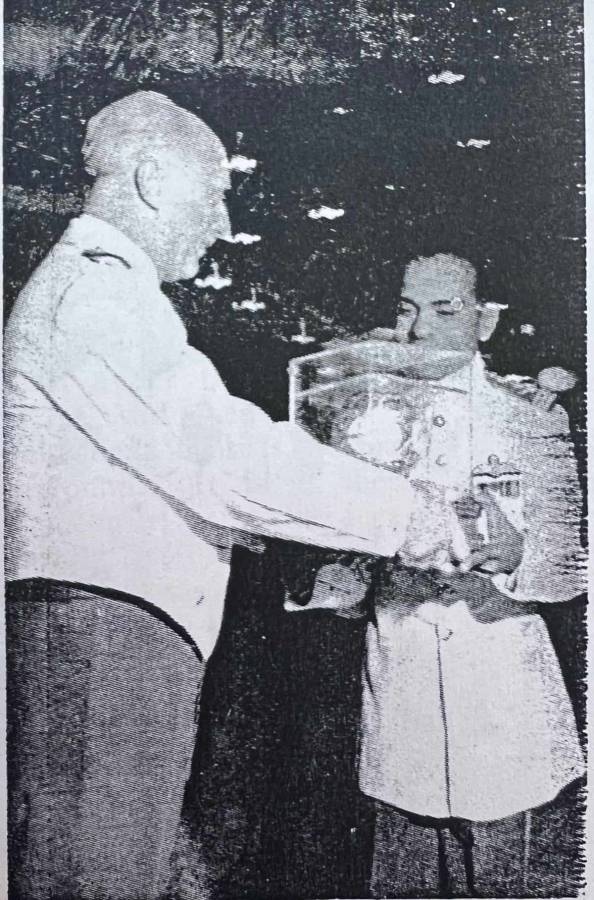
The egg was no ordinary token. As Wing Commander Ramunny held it up, he spoke of its meaning. “This egg,” he said, “represents every cadet’s journey through our halls. The JSW takes these fledglings as they emerge from their shells and teaches them to walk, instilling strength, discipline, and honour in them. But when they are ready, we send them here, to the Air Force Academy, where they learn not just to walk but to fly.”
His words hung in the air as he continued, his voice imbued with a pride that only those who have nurtured young minds can feel. “This egg is a symbol not just for the Air Force Cadets but for every cadet who walks through the Academy’s gates, whether they take to the skies, the seas, or the land. It speaks of protection, of nurturing, of confidence. It reminds them that the wings they earn here will shelter them in peace and guide them in war.”
The double ostrich egg—a fragile yet resilient symbol of their transformation—was a gift that would remain etched in their memories. The following morning, as the JSW contingent bid farewell to their friends now wearing the coveted stripes, there was a pause—a final salute shared not just in form but in spirit. Chaman Lal Gupta and his fellow Pilot Officers were now the vanguards of a legacy, the first of what would become generations of officers moulded by the academy’s ideals.
Chaman Lal Gupta’s journey had only just begun. After commissioning, he joined the transport stream, eventually rising to command 33 Squadron in 1967. He served in Air India after he was released from the IAF in 1970, imparting his knowledge to a new generation of aviators. Yet, he never forgot that cold January morning in Jodhpur, the solemn weight of the double ostrich egg, or the pride that had filled him when the Air Marshal pinned the wings to his chest.
When Chaman Lal Gupta passed away in Mumbai on September 1, 2017, at the age of 86, he left behind a personal legacy and a symbolic one intertwined with the legacy of the double ostrich egg. Since that fateful morning in Jodhpur, the National Defence Academy has trained and commissioned over 5,000 officers into the Indian Air Force. Each carries the invisible weight of that double ostrich egg—a reminder that they were born to fly, protect, and serve.
The morning after the parade, the JSW contingent left Jodhpur, bidding farewell to their newly commissioned comrades. As they parted, they gave the young Pilot Officers—the vanguard of the academy’s legacy—what they called “the smartest salute an officer ever got.” It was a send-off filled with pride and the knowledge that these officers would be the first of many.
Two other key figures in that historic moment would leave their legacies. Group Captain Surendra Nath Goyal, who presented the double ostrich egg, rose to the rank of Air Vice Marshal, retiring in 1968 after a final posting as Commandant of the National Defence Academy from 1966 to 1968. Wing Commander Murkot Ramunny, the Chief Instructor of the JSW during its formative years from 1951 to 1954, played a critical role in shaping its early cadets. He later moved to the Ministry of External Affairs in 1956. Both Goyal and Ramunny passed away in 2009.

I wonder where is the Ostrich Egg now…
⭐ This post previously received 4.9/5 from 137 readers in our legacy system.


Leave a Reply