
The Indo-Pak conflict had escalated, and the Indian Air Force was mounting offensives to cripple Pakistan’s military infrastructure. Among the roaring Su-7s that spearheaded India’s air campaign was one flown by Wing Commander Harcharan Singh Manget. As he guided his formation into hostile airspace, anti-aircraft fire lit up the skies. Suddenly, Manget’s aircraft shuddered violently—a missile had struck his Su-7. Simultaneously, an enemy Sabre locked onto him, its guns blazing. Manget’s survival seemed impossible. Yet, he managed to navigate his damaged aircraft back to base.
For this extraordinary act, Harcharan Singh Manget became one of only nineteen Indian Air Force officers to receive the Maha Vir Chakra, India’s second-highest military honour. Yet, despite this distinction, his remarkable life story remains scattered across fragmented records and is often overlooked in historical narratives.
Early Years
Born on June 6, 1932, in the village of Katani Kalan in Ludhiana, Punjab, Air Commodore Harcharan Singh Manget was the eldest of five brothers and one sister and was a spirited and active child with a passion for sports. His early years, however, were marked by a turning point that instilled the discipline and determination that would define his life. When his father, a retired gazetted officer and accomplished sportsman, noticed Manget falling into poor habits—neglecting his studies and keeping late hours—he decided on a drastic course of action. One cold December night, he ordered Manget to leave the house with nothing to his name. Left to endure the biting cold, Manget eventually fell asleep near the gate, only to be quietly brought back inside by a compassionate cousin. Although no words were exchanged, the incident left a lasting impression on Manget, who later described it as a harsh but valuable lesson.
Manget’s fascination with the Indian Air Force led him to join the first batch of apprentices at the newly established Air Force Technical College in Jalahalli, Bangalore, in 1949. The institution, run by instructors from Hamble College in England, quickly earned a reputation for technical excellence. Manget excelled as an apprentice, but his dreams extended beyond engineering—he wanted to fly. His relentless pursuit finally paid off when he was selected for pilot training and commissioning as an officer.

However, fate had its plans, subjecting him to a series of bureaucratic missteps and delays. Initially selected for the 60th commissioning course, he was bumped to a later batch to accommodate another airman. Later, his name was inexplicably left out of the revised list altogether. Despite these setbacks, Manget’s perseverance saw him through. He finally earned his place in the 62nd commissioning course and received his much-coveted pilot’s wings on January 16, 1954. This delay, however, had far-reaching consequences, determining his time in service and leading to his retirement as an Air Commodore—a twist of fate that would profoundly impact his life.
Young Fighter Pilot
Manget was selected for the fighter stream. He began his operational flying career with No. 7 Squadron, flying Vampire jets. In 1955, he was part of the Republic Day fly-past, a proud moment for the young officer. Later that year, Manget transitioned to the Dassault Ouragan, known in the IAF as the Toofani, with No. 3 Squadron. In 1957, as the IAF prepared to induct the sleek Mystère IV, Manget was selected for advanced training in France. Returning home, he served with No. 1 and No. 3 Squadrons until 1959, further cementing his reputation as a skilled pilot.

Instructional Tenures
After gaining five years of operational experience, Manget was sent for the Junior Commanders’ Course and later trained as a flying instructor at the 25th Flying Instructors’ Course at Tambaram in August 1959. Over the next seven years, from 1959 to 1966, Manget served as a flying instructor, coinciding with the IAF’s rapid expansion following the 1962 Sino-Indian War.
Manget’s first four years as an instructor were spent at the Air Force Flying College in Jodhpur, where he trained pilots in basic and intermediate flying techniques. From 1963 to 1966, he served as a Flight Commander at the Jet Training Wing in Bidar and Hakimpet, transforming young aviators into combat-ready fighter pilots. His consistent dedication to training earned him recognition: in 1964, the Air Officer Commanding-in-Chief of Training Command commended Manget for completing an extraordinary 97 hours of instructional flying in just three weeks —a feat that highlighted his tireless work ethic during one of the IAF’s most demanding periods.

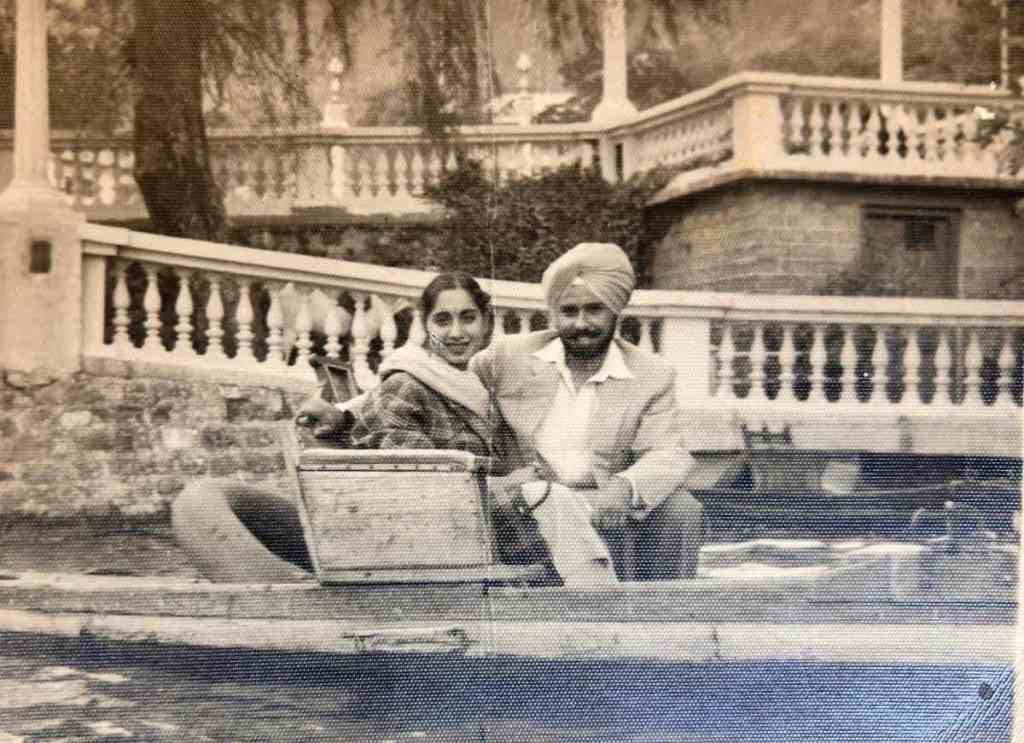
Beyond his professional achievements, Harcharan Singh Manget was a man of deep spirituality and unshakeable faith. As a devout Sikh, he maintained his uncut hair and beard with pride and tied a neat turban that symbolised his values of discipline and tradition. Regular visits to the Gurdwara were a cornerstone of his life, even amid his demanding career. Despite the pressures of his responsibilities, Manget never wavered in his duty to his family, regularly sending money home to support his parents, embodying the Sikh ideals of service and commitment.
His personal life was anchored by his wife, Gurjit, who described him as quiet, gentle, and action-oriented. Their love story began serendipitously in Ambala, where Gurjit was pursuing her Master’s degree. Choosing love over academics, she prioritised their relationship and became a pillar of support as they built a close-knit family. Together, they raised three children—Chinky, their son, and daughters Gigi and Sabina. Following his father’s footsteps of service, Chinky (Madhubir Singh Mangat) joined the Indian Army and eventually retired as a Colonel.

Moving to the Su-7 fleet
In October 1966, Manget transitioned to an academic role, serving as directing staff at the College of Air Warfare. However, his passion for operational flying remained undiminished. He returned to combat duties in 1968, initially as Flight Commander of No. 3 Squadron, where he resumed flying the Mystère IV—a familiar aircraft he had previously mastered. In April 1969, Manget transitioned to the Indian Air Force’s latest acquisition, the Su-7 fighter-bomber, when he was appointed Flight Commander of No. 101 Squadron. This assignment began his association with the formidable Su-7, an aircraft renowned for its deep interdiction capabilities.
In September 1970, Manget was promoted to Wing Commander and assumed command of No. 32 Squadron, which was also equipped with Su-7s and based at Ambala. This period was a defining chapter in his career. Beyond his operational responsibilities, Manget developed a keen interest in photography, a skill he had first developed during his 1957 training in France for the Mystère conversion. There, he purchased a Rolleiflex camera and an 8mm Paillard Bolex movie camera, developing an enduring interest in photography. His logbook provides a glimpse into this critical phase, recording missions in October 1971 over Sialkot, followed by reconnaissance sorties over Mirpur and Haji Pir in November 1971.

When war broke out on December 3, 1971, the six Su-7 squadrons became the backbone of the IAF’s daytime strike capability, flying nearly 1,500 offensive sorties. Their operations spanned counter-air missions, short-term interdiction, close air support, and tactical reconnaissance. The first counter-air strikes on December 4 saw Su-7s, supported by MiG-21s for top cover, attacking key Pakistani airfields. No. 32 Squadron, under Manget’s command, was assigned critical targets, including Shorkot and Sargodha.
Command of No.32 Squadron
By the early hours of December 4, the runway at Amritsar, damaged in a prior Pakistani attack, had been swiftly repaired, allowing MiG-21s to operate as escorts. It was the Su-7s that led the retaliatory strikes that morning. Eagle Formation, under Squadron Leader V.K. Bhatia (“Jimmy”), struck Shorkot with significant effect. Bhatia’s formation, including Flight Lieutenants A.V. Sathaye, V.V. Tambay, and M.S. Grewal, inflicted considerable damage on the target. To confirm the success of this attack, Manget undertook a high-speed photo reconnaissance sortie to capture crucial evidence of the operation’s impact.
In the afternoon, it was Manget’s turn to lead. Commanding Thunderbird Formation, Manget, alongside Squadron Leader P. Singh (“Pat”), Squadron Leader A.M. Mehta (“Chhotu”), and Flight Lieutenant S.D. Gaurishankar (“Gauri”) prepared for a daring strike on the heavily defended Sargodha airbase. The decision to launch the attack in broad daylight was bold, perhaps even perplexing. Daytime missions were hazardous against a prepared and well-defended adversary. However, the attack proceeded as planned, even without the MiG-21 escorts, showcasing the resolve and courage of the Indian pilots.

The mission was fraught with danger. As Thunderbird entered Pakistani airspace in the late afternoon, they faced continuous anti-aircraft fire. The Pakistan Air Force, aware of the Su-7’s operational limitations, attempted to exploit its predictable attack profiles. As they approached the Initial Point, Squadron Leader Pat Singh’s aircraft was hit by tracers, and a missile narrowly missed him before striking Manget’s Su-7.
Manget’s aircraft momentarily disappeared, only to re-emerge trailing smoke with its tail parachutes ablaze. The situation worsened as an enemy Sabre targeted Manget’s damaged aircraft, unleashing bursts from its eight Browning machine guns. Quickly assessing the situation, Pat fired his 30 mm cannons to divert the Sabre. Although out of effective range, Pat’s bold action gave Manget the critical seconds to recover and manoeuvre.
The return to base was harrowing. His Su-7 had sustained extensive damage: the port wing fuel tank was ruptured, the port stabiliser sheared off along with much of the rudder surface, the tail chute was blown away, and the right aileron and flap were severely damaged. The starboard stabiliser was partially destroyed, and the underside of the fuselage was riddled with bullet holes. Manget’s skill and composure enabled him to return the aircraft to base despite the extensive damage. The aft section of his aircraft is on display at the IAF Museum in Palam, commemorating this remarkable mission.

It wasn’t until the next day, when Squadron Leader Pat Singh’s gun camera footage was processed that the full extent of the engagement was revealed. The footage confirmed the presence of two Pakistani Sabres and documented the intense aerial combat that unfolded. It also became evident that Manget’s Su-7 had been struck by a Sidewinder missile rather than ground fire, as initially reported. This misclassification, common in the chaos of war, meant that official records did not fully capture the challenges Manget faced during the engagement.
Since World War II, military honours have been divided into immediate awards, given for a single extraordinary act of gallantry, and non-immediate awards, which recognise sustained leadership in combat. Manget’s remarkable feat of landing a severely damaged aircraft after being hit inside enemy territory was a textbook example of bravery that earned an immediate award. He was conferred the Maha Vir Chakra for this act, one of India’s highest military honours. Following this, Manget continued to lead his squadron in more close support missions and numerous photographic reconnaissance sorties until the war ended.
No. 32 Squadron played a pivotal role during the 1971 war, flying numerous sorties that included three successful and one attempted strike on Shorkot Road (renamed PAF Base Rafiqui) and Sargodha, along with two reconnaissance missions to Chaklala and Murid. These missions were complemented by interdiction operations targeting enemy supply lines and infrastructure. Operating out of Amritsar, the squadron lost three aircraft during the war, all to enemy anti-aircraft fire. Two of these losses occurred during strikes on Shorkot Road, where Squadron Leader Jimmy Bhatia led three impactful missions on December 4 and 5, inflicting significant damage on the airfield and destroying several parked aircraft.

Death and legacy
In May 1973, Wing Commander Harcharan Singh Manget handed over command of No. 32 Squadron and was posted as Officer-in-Charge Flying at No. 8 Wing in Adampur. Despite his new administrative role, Manget’s active engagement with flying continued. In 1974, he achieved a rare distinction by winning the prestigious Arjuna trophy for bombing, a notable achievement for someone serving as OC Flying of an airbase. This accolade added to his earlier recognition for excellence in rocketry.

Over the next decade, his career progressed steadily. In 1975, he was given command of the newly formed No. 260 Signal Unit at Jammu, followed by commands of Air Force Station Bareilly and Air Force Station Srinagar, interspersed with the high defence management course at NDC. His promotion to Air Commodore, ahead of any in his course, was a testament to his capability and leadership. However, the delay in his commissioning earlier in his career meant he reached the age of superannuation before achieving higher ranks. Manget retired in June 1986 at the age of 54.
Manget’s passion for flying remained undiminished, and he joined Pawan Hans Helicopters, continuing to contribute as a pilot. Tragically, on July 14, 1988, Manget’s life was cut short in a helicopter crash near the Sanjichat helipad in Vaishno Devi. The Westland 30 helicopter was notorious for reliability issues, with Pawan Hans experiencing several losses involving the type. During the flight, adverse weather conditions and dense cloud cover caused the helicopter to collide with a ‘Chir’ tree on a hillside. The resulting impact and post-crash fire destroyed the helicopter, killing all seven occupants, including Manget. It was an untimely and tragic end for a pilot whose career demonstrated commitment and perseverance.

On a lighter note, Manget’s heroics may have inspired a memorable moment in Indian cinema. A scene from the Hindi movie Hindustan Ki Kasam (1973), depicting a damaged Gnat landing back after a mission, appears to draw parallels with Manget’s real-life feat of bringing his crippled Su-7 safely home. Whether coincidental or intentional, the imagery serves as a cultural nod to the bravery Manget exemplified.
Reflecting on his career, one might wonder how much further Manget could have advanced had he not faced delays during his early commissioning. Over his illustrious career, Manget logged 4,991 flying hours across 19 types of aircraft, including 4,721 hours on fixed-wing planes, 270 hours on helicopters, and 1,700 hours dedicated to instructional flying. His life and legacy exemplify the dedication and skill of a distinguished IAF officer.

⭐ This post previously received 5.0/5 from 70 readers in our legacy system.


Leave a Reply