

The “42 Squadron” itch has recently been the center of attraction and concern. This thread analyses the evolution of the combat fleet (& the number 42) of the IAF juxtaposed with the geopolitical & economic shifts through India’s 80-year journey. (1/21)
There is no gainsaying that India is a vast country. Over decades, her rulers & their threats have changed, as have her alignments. Threats to the Raj varied from the North-West to peninsular India & finally, to the East. All this manifested itself in the state of Airpower. 2/
As the nature of the Great Games varied, so did the equipment profile. The primary mil tool for the Raj was the British Indian Army – joined by the RAF in 1918 as part of Trenchards ‘strategy of substitution’ that made airpower the better option, initially deployed in NWFP. 3/

Its first elements included 2 Sqns & about 700 personnel, increasing to 8 Sqns in 2 years. While the main op area was the Frontier, some R&R bases were opened in hinterland India. In 1933, No 1 IAF Sqn joined the cause with the RAF, but Nos remained largely unchanged in 1939. 4/

At the peak of the WWII Burma campaign, Air Forces in India measured at about 65 Sqns and 207,000 personnel (incl 15,000 officers). Is it that the threat (then & now) from the East demands a much larger force than the West? Well, an independent India was only looking west..5/

At the dawn of independence, the IAF had 10 Sqns, of which 9 were combat Sqns. But 4 of them (Nos 1,2,6 & 9) were number-plated due to lack of equipment or personnel, leaving us as a 5 combat Sqn force – all looking west towards Pakistan. 6/

Post-independence plans asked for a 20 Sqn IAF, of which 15 (11 combat Sqns) were approved by Dec 53. With Pak joining Western Alliances & China threat emerging, IAF increased the ask. The govt approved a total force of 23 Sqns (1959) & 33 Sqns (1961) plus ancillary units. 7/

The 1950s approval for augmentation & refitting the legacy fleet with modern ac had a thoughtful mix of French & British-origin fighters that optimized needs, delivery timelines, supply diversification, & costs. The contracts signed up led to 24 Sqn worth of aircraft by 1965. 8/

The big jump, however, came just before the War with China, when in Oct 1962. The Tata Committee had recommended a 64 Sqns (50 Combat Sqns) force. The Govt approved 45 Sqns (of which 35 were combat Sqns), due to financial constraints. 9/
The authorized strength had moved from ~18 to 35 (Combat Sqns) in just 3 years – A frantic period of recruitment, training & search for aircraft ensued. Notwithstanding, on the eve of the War with China, the IAF had only cobbled up 23 combat Sqns. Better times were ahead. 10/

Soon USSR leveraged its relationship (An-12s, Mi-4s) by offering us low prices for the MiG-21/ Su-7 and a rupee-Rouble contract that suited us economically. The other induction was the indigenized HAL HF-24 Marut. Together these three inductions led to 16 Sqns in 1971. 11/

From 1953 to 1968 can be termed extraordinary for IAF – it had diversified suppliers, created competition and better pricing, acquired sufficiently & timely, and even initiated indigenized aircraft designing. The UK itself acknowledged that it had got its policy wrong. 12/

Consequently, by 1971, the IAF had been equipped with 37 fighter Sqns and was well positioned in the 1971 war. This paved the way for IAF’s deeper partnership with USSR in the decades ahead but left us open to engaging with all countries and manufacturing domestically. 13/

IAF made 7 inductions between 1977-87, which included Indian (Ajeet), British (Jaguar), French (Mirage-2000), and Russian (Mig-23,25,27,29)—this time managing to acquire to most modern ac of the time – Mirage-2000 & MiG-29. The competition between suppliers yielded results. 14/

This strategy did have pitfalls. It led to a proliferation of ac types. The IAF had to deal with 7-9 aircraft types resulting in problems with crew manning/ training, spares, & maintenance. It is no surprise that IAF struggled with flight safety and serviceability challenges. 15/
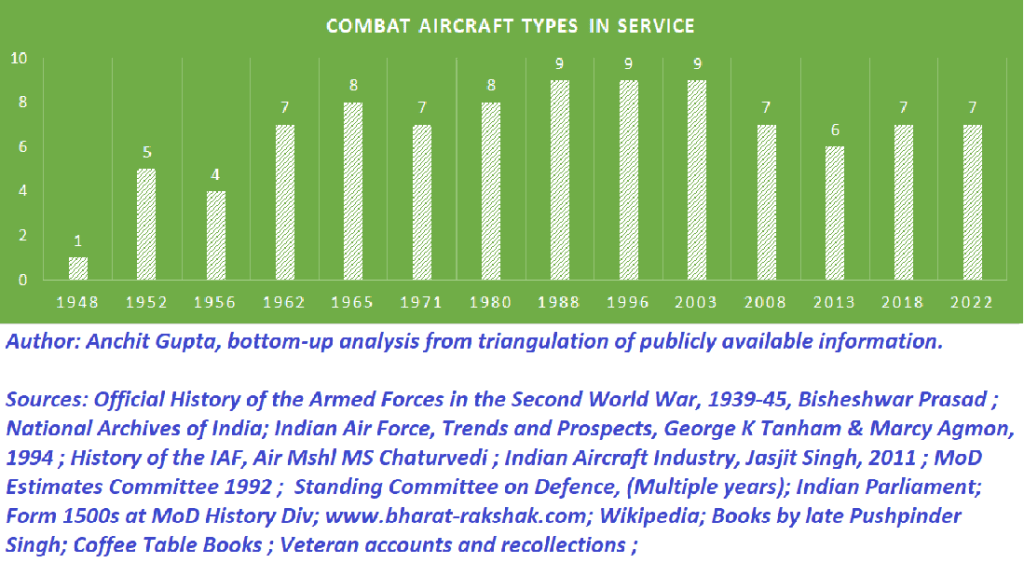
In first 40 years, India managed to induct new types aggressively – 5 in 1950s, 3 in 1960s, 2 in 1970s & 5 in 1980s. In the next 40 years (1987 – 2016), we added only two new types – a lacuna that haunts us. Financial crisis of 90s, & endless wait for indigenous ac to blame. 16/

Consequently, IAF’s combat Sqn strength peaked at 41 in 1996 and, after that, declined gradually. At the same time, the Combat Sqn approved strength crawled up from 35 in 1962 to barely 42 in 2012, despite threats from Pakistan and China across Ladakh, North East & Maritime.17/

This hiatus on new inductions forced IAF to upgrade its fleet. Starting with the MiG-21s, it has upgraded MiG-27s, Mig-29s, and Mirage-2000s, and now we find mention of Su-30s, too, requiring upgrades. By 2008, nearly 75% of IAF Sqn strength was modern’ised’ aircraft. 18/

A consequence of the modern’ised’ era was attrition across types. MiG-21, the first & the largest fleet to be modernised earned the “Flying coffin” monicker, severely denting IAF’s reputation. Watch the IAF chief explain this to NDTV in 2000 – 19/
Modernizing aircraft is a viable strategy for any air force, but it has its shelf life. The delay in alternative inductions has turned modernization into a drawdown period, leaving us at a force level smaller than even the 1971 war. 20/
While the MMRCA, LCA Mk II & later, the AMCA may help it meet its sanctioned 42 combat Sqns, history tells us that the Govt of the day needs to recreate the acquisition magic of the 1950s – 80s to tide over our immediate national needs. (21/21)
Originally published on Twitter


Leave a Reply